Kia Picanto: Forward Collision-Avoidance Assist malfunction and limitations / Limitations of Forward Collision-Avoidance Assist
Forward Collision-Avoidance Assist in the Kia Picanto may fail to operate correctly or may intervene unexpectedly in the circumstances listed below. These conditions can affect detection and the system’s assessment of a possible collision:
-
The detecting sensor or the area surrounding it is dirty, obstructed or damaged.
-
The temperature around the front view camera becomes excessively high or low because of the surrounding environment.
-
The camera’s view is affected by windscreen tinting, film or coating, damaged glass, or material stuck to the glass, such as stickers or insects.
-
Moisture remains on the windscreen or has frozen onto the glass, preventing a clear view.
-
Windscreen washer fluid is being sprayed continuously, or the windscreen wipers are operating.
-
The vehicle is travelling through heavy rain, heavy snow or dense fog.
-
Strong sunlight or glare obstructs the front view camera’s field of vision.
-
Street lighting or the headlights of approaching vehicles reflect from wet road surfaces or puddles.
-
An object has been placed on top of the instrument panel.
-
Your vehicle is being towed by another vehicle.
-
The surroundings are extremely bright or very dark, such as inside a tunnel.
-
Ambient brightness changes abruptly, for example when entering or leaving a tunnel.
-
Outside light levels are low and your headlights are switched off or provide insufficient illumination.
-
Only part of a vehicle, powered two-wheeler, pedestrian or cyclist is visible to the detecting system.
-
The road user ahead has a difficult-to-recognise profile, such as a bus, heavy truck, truck carrying an unusually shaped load or trailer.
-
The vehicle ahead has no tail lights, or its tail lights are mounted in unusual positions.
-
Ambient light is low and the tail lights of the vehicle ahead are off or too dim.
-
The rear profile of the vehicle ahead is small or unusual, or the vehicle is tilted, overturned or positioned so that its side is visible.
-
The vehicle ahead has unusually low or high ground clearance.
-
A vehicle, powered two-wheeler, pedestrian or cyclist suddenly moves into your path.
-
The system detects the vehicle or powered two-wheeler ahead later than expected.
-
An obstacle suddenly blocks the view of the vehicle or powered two-wheeler ahead.
-
The vehicle or powered two-wheeler ahead changes lanes abruptly or suddenly reduces speed.
-
The vehicle or powered two-wheeler ahead is damaged or distorted in shape.
-
The vehicle ahead is travelling at a particularly high or low speed.
-
The vehicle ahead steers in the opposite direction to your vehicle while attempting to avoid a collision.
-
You change lanes at low speed while another vehicle is ahead of you.
-
Snow covers the vehicle ahead and obscures its normal outline.
-
Your vehicle is leaving its lane or moving back into it.
-
The vehicle is being driven unstably or its movement is irregular.
-
You are travelling around a roundabout and the system does not detect the vehicle or powered two-wheeler ahead.
-
You continue driving in a circular path.
-
The vehicle or powered two-wheeler ahead has an unusual shape that makes recognition difficult.
-
The vehicle or powered two-wheeler ahead is travelling uphill or downhill.
-
A pedestrian or cyclist is not fully recognised, for example because the person is leaning forwards or is not walking upright.
-
A pedestrian or cyclist wears clothing or carries equipment that makes their outline difficult to detect.
The illustration above shows the profiles that the front view camera and, where fitted, front radar are intended to recognise as vehicles, powered two-wheelers, pedestrians and cyclists. A partial or unusual outline can make recognition more difficult.
-
The pedestrian or cyclist ahead is moving very quickly.
-
The pedestrian or cyclist ahead is short or is in a low posture.
-
The pedestrian or cyclist ahead has limited mobility or moves across the vehicle’s direction of travel.
-
A group of pedestrians, several cyclists or a large crowd is ahead of the vehicle.
-
A pedestrian’s or cyclist’s clothing blends into the background, making the person difficult to distinguish.
-
A pedestrian or cyclist is difficult to separate visually from nearby structures with a similar shape.
-
You pass pedestrians, cyclists, traffic signs or other structures near an intersection.
-
You are driving in any of the following environments or locations:
-
Through steam, smoke or areas of shadow.
-
Through a tunnel or across an iron bridge.
-
Across open areas with few vehicles or structures, such as deserts, meadows or sparsely developed suburban areas.
-
Within a car park.
-
Through toll gates, roadworks, partly paved roads or uneven surfaces, or over speed bumps.
-
Near areas containing substantial metal structures or materials, such as construction sites or railway lines.
-
On sloping or curved roads.
-
Along roads bordered by trees or streetlights.
-
Along a narrow road with overgrown trees or grass.
-
Through an area with strong radio signals or electrical noise that causes electromagnetic interference.
-
-
Poor road conditions cause excessive vibration as the vehicle moves.
-
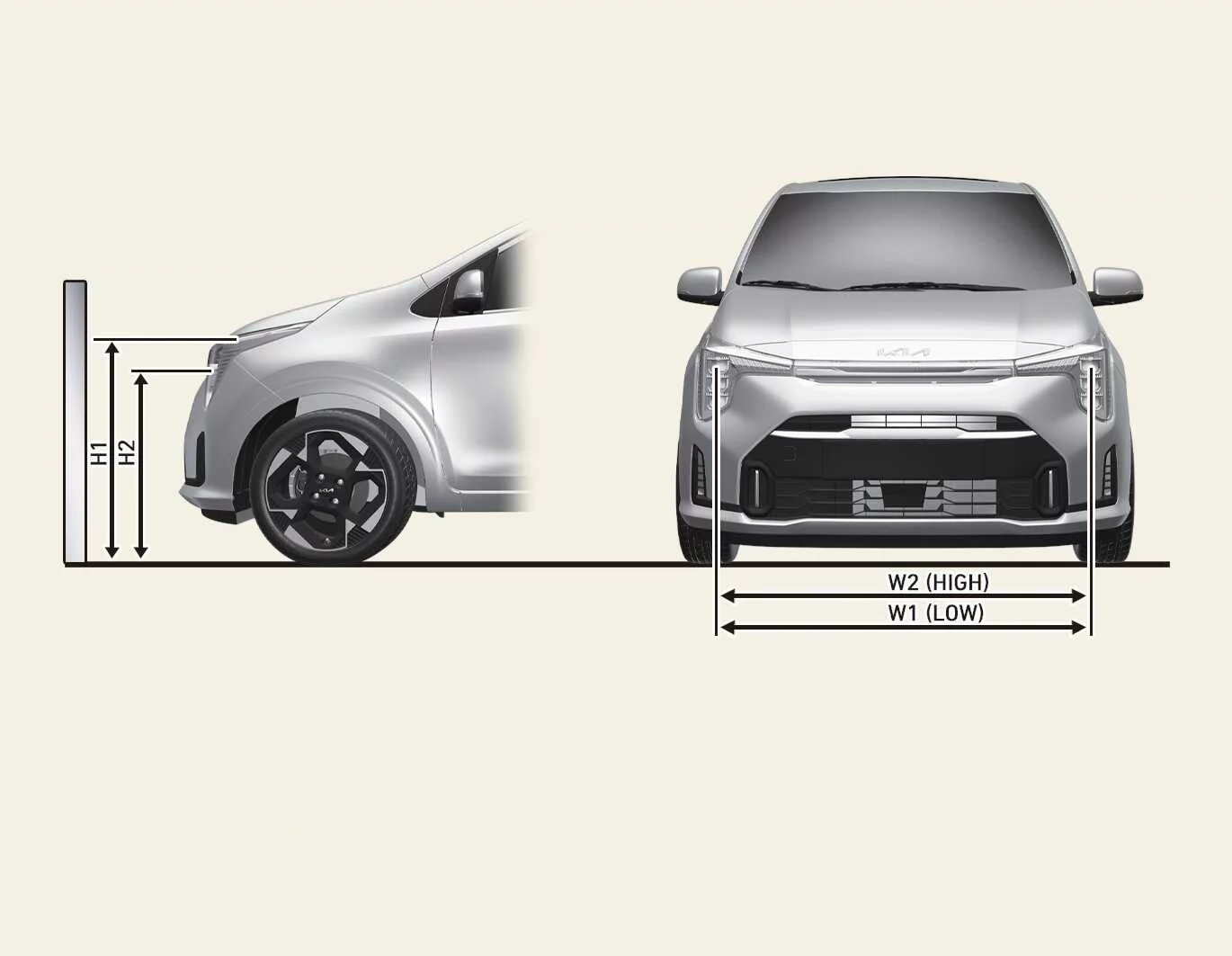
The vehicle sits higher or lower than normal because of heavy loading, incorrect tyre pressures or similar conditions.
-
Tyre chains, a spare tyre or a wheel of a different size are fitted to the vehicle.
WARNING
-
Driving on a curved road
On a curved road, the sensors may not correctly detect a vehicle, powered two-wheeler, pedestrian or cyclist ahead. As a result, Forward Collision-Avoidance Assist may provide neither a warning nor braking assistance when intervention is needed.
Maintain a safe braking distance while cornering. Watch the road ahead, steer as necessary and apply the brake pedal to reduce speed whenever needed to preserve a safe gap.
A bend can also cause Forward Collision-Avoidance Assist to detect a vehicle, powered two-wheeler, pedestrian or cyclist in the adjacent lane or outside your lane.
This may trigger an unnecessary warning or braking intervention. Continue to monitor traffic around your Kia Picanto so that you understand the situation and remain ready to control the vehicle.
-
Driving on an inclined road
Uphill and downhill gradients can affect sensor performance, preventing correct detection of vehicles, powered two-wheelers, pedestrians or cyclists ahead.
The system may issue a warning or apply braking unnecessarily. Conversely, it may fail to warn or assist with braking when a genuine collision risk exists.
If a road user ahead suddenly enters the detection area, the system may respond with braking that rapidly reduces vehicle speed.
Keep watching the road when travelling uphill or downhill. Steer appropriately and use the brake pedal whenever necessary to control your speed and maintain a safe distance from traffic ahead.
-
Changing lanes
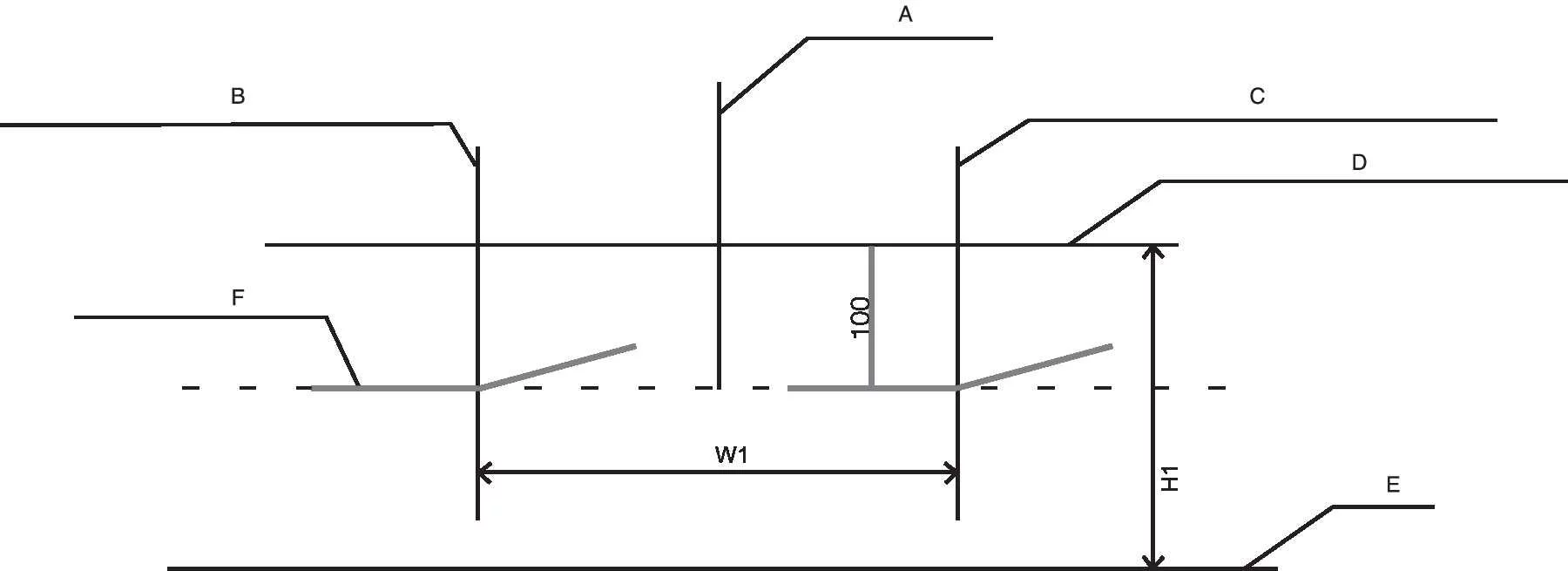
[A]: Your vehicle
[B]: Vehicle or powered two-wheeler changing lanes
When a vehicle or powered two-wheeler (B) enters your lane from an adjacent lane, the sensor cannot detect it until it moves within the detection range.
An abrupt lane change may therefore leave Forward Collision-Avoidance Assist unable to recognise the road user immediately. Maintain enough braking distance to respond yourself, steering as necessary and pressing the brake pedal to reduce speed and preserve a safe gap.
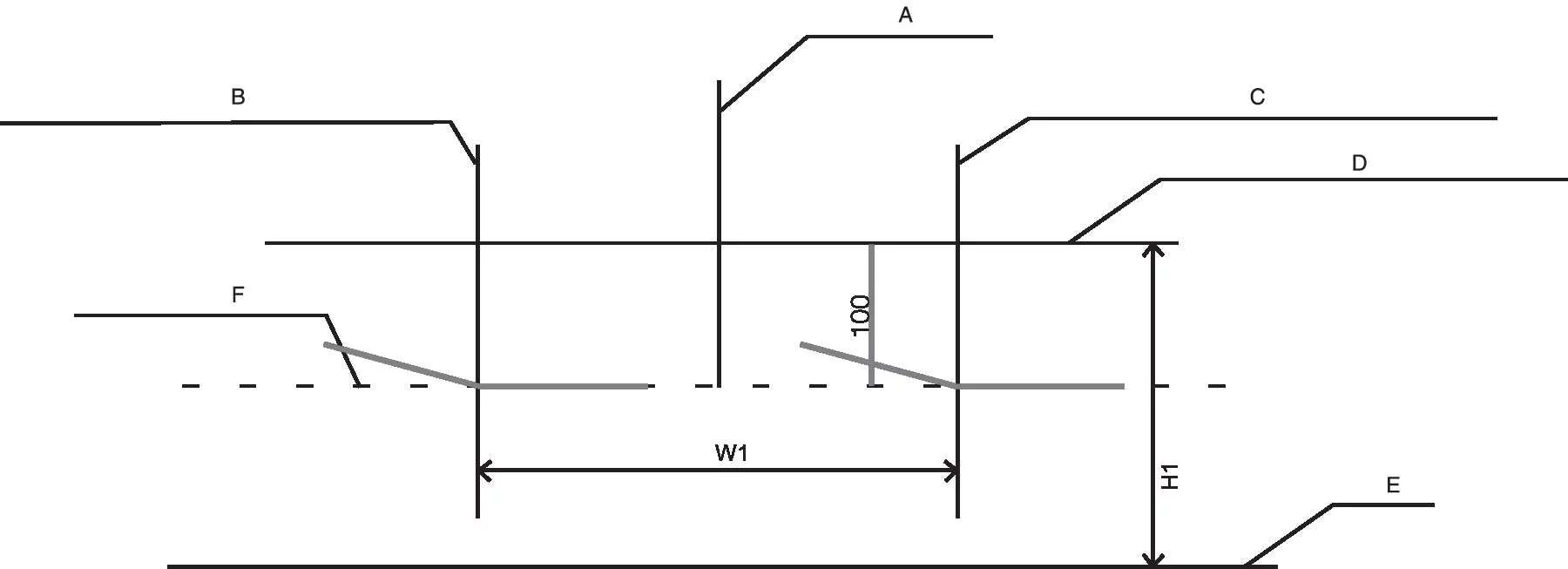
[A]: Your vehicle
[B]: Vehicle changing lanes
[C]: Vehicle or powered two-wheeler in the same lane
When the vehicle directly ahead (B) leaves your lane, it may reveal another vehicle or powered two-wheeler (C) that the system has not yet detected. Forward Collision-Avoidance Assist may not respond immediately to this newly exposed road user. Keep a safe braking distance, watch beyond the nearest vehicle where possible, and steer or brake as necessary to maintain separation.
-
Detecting vehicle
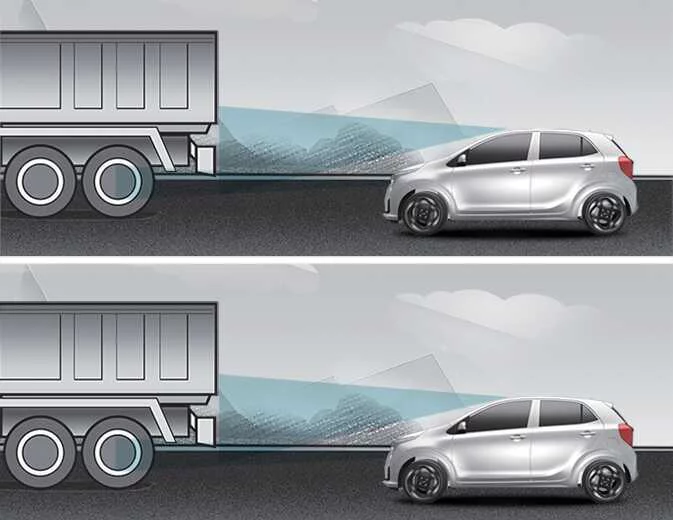
Take extra care when following a vehicle with cargo extending behind its cab or with unusually high ground clearance. Forward Collision-Avoidance Assist may fail to recognise the projecting load. Judge your following distance from the rearmost part of the load or vehicle, rather than from the cab alone. Steer appropriately and apply the brakes whenever necessary to reduce speed and keep a safe distance.
WARNING
-
For safety, switch off Forward Collision-Avoidance Assist when using your Kia Picanto to tow a trailer or another vehicle.
-
Objects that resemble vehicles, powered two-wheelers, pedestrians or cyclists in shape or other characteristics may cause the system to activate unexpectedly.
-
Do not rely on Forward Collision-Avoidance Assist to respond to bicycles alone or smaller wheeled objects, including wheeled luggage, shopping trolleys and pushchairs. These objects are outside the operation described for detected cyclists.
-
Strong electromagnetic interference can prevent Forward Collision-Avoidance Assist from operating correctly.
-
Forward Collision-Avoidance Assist may be unavailable for 15 seconds after the vehicle starts or while the front view camera is initialising. Remain prepared to respond without its assistance during this period.
 Forward Collision-Avoidance Assist malfunction
A: Check forward safety system
If Forward Collision-Avoidance Assist is..
 Forward Collision-Avoidance Assist (FCA) (Sensor Fusion): (if equipped)
Basic function
Forward Collision-Avoidance Assist in the Kia Picanto detects vehicles, powered two-wheelers, pede..
Other information:
Ford Explorer 2020-2026 Service Manual: Removal and Installation - Transmission Fluid Pump
Removal Remove the main control valve body. Refer to: Main Control Valve Body (307-01A Automatic Transmission - 10-Speed Automatic Transmission – 10R60, Removal and Installation). Remove the bolts and the transmission fluid pump...
Ford Explorer 2020-2026 Service Manual: Removal and Installation - Brake Disc Shield
Removal NOTE: Removal steps in this procedure may contain installation details. Remove the brake disc. Refer to: Brake Disc (206-03 Front Disc Brake, Removal and Installation). Remove the 3 bolts and the brake disc shield...
Categories
- Manuals Home
- 6th Generation Explorer Owners Manual
- 6th Generation Explorer Service Manual
- General Service Information
- Interior Trim and Ornamentation
- Auxiliary Power Points
- New on site
- Most important about car
Driver and Passenger Airbags
WARNING: Do not place your arms on the airbag cover or through the steering wheel. Failure to follow this instruction could result in personal injury.
WARNING: Keep the areas in front of the airbags free from obstruction. Do not affix anything to or over the airbag covers. Objects could become projectiles during airbag deployment or in a sudden stop. Failure to follow this instruction could result in personal injury or death.
WARNING: Airbags can kill or injure a child in a child restraint. Never place a rear-facing child restraint in front of an active airbag. If you must use a forward-facing child restraint in the front seat, move the seat upon which the child restraint is installed all the way back.