
Kia Picanto: Forward Collision-Avoidance Assist (FCA) (Front Camera Only): (if equipped) / Forward Collision-Avoidance Assist operation. Basic function
Basic function
Forward Collision-Avoidance Assist in the Kia Picanto provides warnings and braking assistance through the following stages, depending on the detected collision risk and operating conditions:
-
Collision warning to alert the driver to a possible impact.
-
Emergency braking assistance to help avoid a collision.
-
Stopping the vehicle and ending automatic brake control.
Collision Warning
|
A: Collision Warning |
When Collision Warning activates, the Forward Safety warning light ( ) flashes, a
warning message appears and an audible alert sounds. These warnings draw your attention to the detected risk so that
you can respond.
Collision Warning can activate within the following vehicle-speed ranges, depending on the type of road user detected ahead:
-
Vehicle or powered two-wheeler: 10–180 km/h (6–112 mph).
-
Pedestrian or cyclist: 10–80 km/h (6–50 mph).
Emergency Braking
|
|
A: Emergency Braking |
During Emergency Braking, the Forward Safety warning light () flashes
alongside a displayed message and an audible warning. The system also activates braking assistance to help avoid a
collision with a detected vehicle, powered two-wheeler, pedestrian or cyclist.
Emergency Braking can activate within the following vehicle-speed ranges when the other operating requirements are met:
-
Vehicle or powered two-wheeler: 10–60 km/h (6–37 mph).
-
Pedestrian or cyclist: 10–60 km/h (6–37 mph).
CAUTION
-
The operating range may be reduced by traffic conditions ahead or by the environment around the vehicle. Being within a listed speed range does not guarantee that assistance will activate.
-
Recognition of powered two-wheelers is less effective at night. As a result, Forward Collision-Avoidance Assist may be temporarily limited or may not operate when approaching these road users in darkness.
Stopping vehicle and ending brake control
|
|
A: Drive carefully |
If emergency braking brings the vehicle to a complete stop, a warning message appears in the instrument cluster.
Immediately depress the brake pedal to take responsibility for holding the vehicle stationary, and check the surrounding traffic and road conditions.
-
Automatic brake control ends approximately 2 seconds after emergency braking has stopped the vehicle. Do not rely on the system to keep the vehicle stationary beyond this brief period.
NOTE
The audible alert during Collision Warning or Emergency Braking can be silenced by pressing the hazard warning light switch.
WARNING
-
Park your Kia Picanto in a safe location before changing driver assistance settings. Make adjustments only after the vehicle is safely parked.
-
You remain responsible for controlling the vehicle at all times. Do not rely solely on Forward Collision-Avoidance Assist to prevent an impact. Maintain a safe braking distance and press the brake pedal whenever necessary to reduce speed or stop.
-
Never deliberately drive towards people, objects or other obstacles to test or trigger Forward Collision-Avoidance Assist. Attempting to provoke system intervention can cause serious injury or death.
-
Forward Collision-Avoidance Assist may not activate if you are already pressing the brake pedal to avoid a collision. Continue to apply the braking needed for the situation.
-
Road and driving conditions can affect warning timing. The system may alert you later than expected or may provide no warning, so keep watching the road ahead.
-
The vehicle may stop abruptly during system intervention, potentially injuring passengers or causing unsecured objects to move. Always wear your seat belt and keep loose items securely stored.
-
If another vehicle system is displaying a warning message or sounding an alert, the Forward Collision-Avoidance Assist message or audible warning may not be provided at the same time.
-
Noise inside or around the vehicle may prevent you from hearing the collision warning. Do not depend on the audible alert alone to recognise a developing hazard.
-
Depending on the road conditions and surrounding environment, Forward Collision-Avoidance Assist may switch off, operate incorrectly or intervene when assistance is unnecessary.
-
A fault in Forward Collision-Avoidance Assist does not, by itself, prevent the vehicle’s basic braking system from operating normally. The driver remains responsible for using the brake pedal.
-
During emergency braking, automatic brake control is cancelled if you press the accelerator excessively or steer sharply. These driver inputs can override the system’s braking intervention.
CAUTION
-
The circumstances of the vehicle, powered two-wheeler, pedestrian or cyclist ahead, together with the surrounding conditions, can narrow the speed range in which assistance operates. The system may provide only a warning without braking assistance, or it may not operate at all.
-
Forward Collision-Avoidance Assist operates only under certain conditions. It assesses collision risk using factors such as the situation of an approaching vehicle or powered two-wheeler, the direction of travel, speed and the surrounding environment.
-
The assessment also considers the circumstances of approaching vehicles, powered two-wheelers and cyclists in relation to driving direction and speed. These factors influence the calculated risk level and whether the conditions for collision-avoidance assistance are satisfied.
NOTE
-
If a collision is imminent and the driver’s braking input is insufficient, Forward Collision-Avoidance Assist may provide additional braking assistance. This support does not remove the need for the driver to respond promptly.
-
The images and colours shown in your Kia Picanto instrument cluster may differ from the illustrations. Their appearance depends on the cluster fitted and the display theme selected in the settings menu.
 Forward Collision-Avoidance Assist settings. Warning Methods
Forward Safety
A: Driver Assistance
With the vehicle switched on, ..

Other information:
Ford Explorer 2020-2026 Service Manual: Removal and Installation - Trough Assembly
Removal NOTE: Removal steps in this procedure may contain installation details. Remove the roof opening panel glass. Refer to: Roof Opening Panel Glass (501-17 Roof Opening Panel, Removal and Installation). Remove the roof opening panel fixed glass...
Ford Explorer 2020-2026 Service Manual: Removal and Installation - Rear Lamp Assembly
Special Tool(s) / General Equipment Interior Trim Remover Removal NOTE: Removal steps in this procedure may contain installation details. NOTE: LH lamp assembly shown, RH lamp assembly is similar. Remove the loadspace trim panel...
Categories
- Manuals Home
- 6th Generation Explorer Owners Manual
- 6th Generation Explorer Service Manual
- Description and Operation - Jacking and Lifting - Overview
- Traction Control
- Interior Trim and Ornamentation
- New on site
- Most important about car
Gauges
4 Inch Display
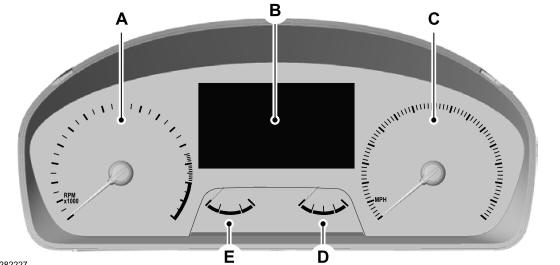
A - Tachometer.
B - Information display.
C - Speedometer.
D - Fuel gauge.
E - Engine coolant temperature gauge.
