
Kia Picanto: Forward Collision-Avoidance Assist operation / Basic function
The basic Forward Collision-Avoidance Assist function provides warnings and braking assistance through the following stages, according to the detected collision risk and the conditions in which the system operates:
-
Collision warning to alert the driver to a possible impact.
-
Emergency braking assistance to help avoid the collision.
-
Stopping the vehicle and ending automatic brake control.
Collision Warning
|
A: Collision Warning |
Collision Warning alerts you with a flashing Forward Safety warning light ( ), a message in the instrument
cluster and an audible warning. These alerts draw your attention to the potential collision ahead.
The warning function operates within the following vehicle-speed ranges, depending on the type of road user detected:
-
Vehicle or powered two-wheeler: 10–200 km/h (6–124 mph).
-
Pedestrian or cyclist: 10–85 km/h (6–53 mph).
Emergency Braking
|
|
A: Emergency Braking |
During Emergency Braking, the Forward Safety warning light () flashes while a warning
message appears and an audible alert sounds.
Braking assistance activates to help avoid a collision with a detected vehicle, powered two-wheeler, pedestrian or cyclist. The available braking level and operating speed range depend on the type of road user and whether it is moving or stationary.
-
Vehicle or powered two-wheeler: The following speed ranges apply to weak and strong braking assistance:
Braking level Moving vehicle or powered two-wheeler Stationary vehicle or powered two-wheeler Weak braking power 10–200 km/h (6–124 mph) Strong braking power 10–130 km/h (6–81 mph) 10–85 km/h (6–53 mph) -
Pedestrian or cyclist: Emergency braking assistance operates within a vehicle-speed range of 10–65 km/h (6–40 mph).
CAUTION
-
Traffic conditions ahead and the surrounding environment may reduce the function’s operating range. Travelling within a listed speed range does not guarantee that braking assistance will activate.
-
Powered two-wheelers are more difficult for the system to recognise at night. Forward Collision-Avoidance Assist may therefore be temporarily limited or may not operate when detecting them in darkness.
Stopping vehicle and ending brake control
|
|
A: Drive carefully |
If emergency braking brings your Kia Picanto to a complete stop, the instrument cluster displays a warning message reminding you to drive carefully.
Immediately depress the brake pedal to hold the vehicle stationary and check the surrounding area. Take control of the stopped vehicle rather than relying on continued automatic braking.
-
Automatic brake control ends approximately 2 seconds after emergency braking has stopped the vehicle. The driver must then maintain the stop using the brake pedal.
NOTE
The audible warning during Collision Warning and Emergency Braking can be silenced by pressing the hazard warning light switch.

 Junction Turning function
The Junction Turning function in the Kia Picanto provides collision alerts and braking assistance through the
following stages, depending on the detected risk and operating conditions:
..
Other information:
Ford Explorer 2020-2026 Service Manual: Description and Operation - Blind Spot Information System - Overview
BLIS® The BLIS® aids the driver in assessing whether another vehicle is present within a specific area (blind spot) to either side of the vehicle, extending rearward approximately 6 m (20 ft) beyond the rear bumper while driving on roads and highways...
Ford Explorer 2020-2026 Service Manual: Removal and Installation - Rear Temperature Door Actuator
Removal NOTE: Removal steps in this procedure may contain installation details. Remove the RH loadspace trim panel. Refer to: Loadspace Trim Panel (501-05 Interior Trim and Ornamentation, Removal and Installation). Disconnect the electrical connector...
Categories
- Manuals Home
- 6th Generation Explorer Owners Manual
- 6th Generation Explorer Service Manual
- Traction Control
- Removal and Installation - Front Halfshaft Speed Sensor
- General Procedures - Rear Camber Adjustment
- New on site
- Most important about car
Child Safety Locks
When these locks are set, you cannot open the rear doors from the inside.
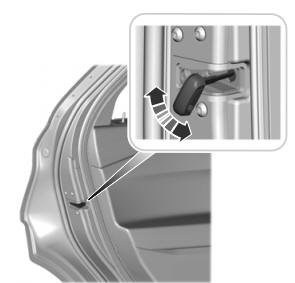
A child safety lock is on the rear edge of each rear door. You must set the child safety lock separately on each door.
Left-Hand Side
