Kia Picanto: Seating and safety restraints / Seats
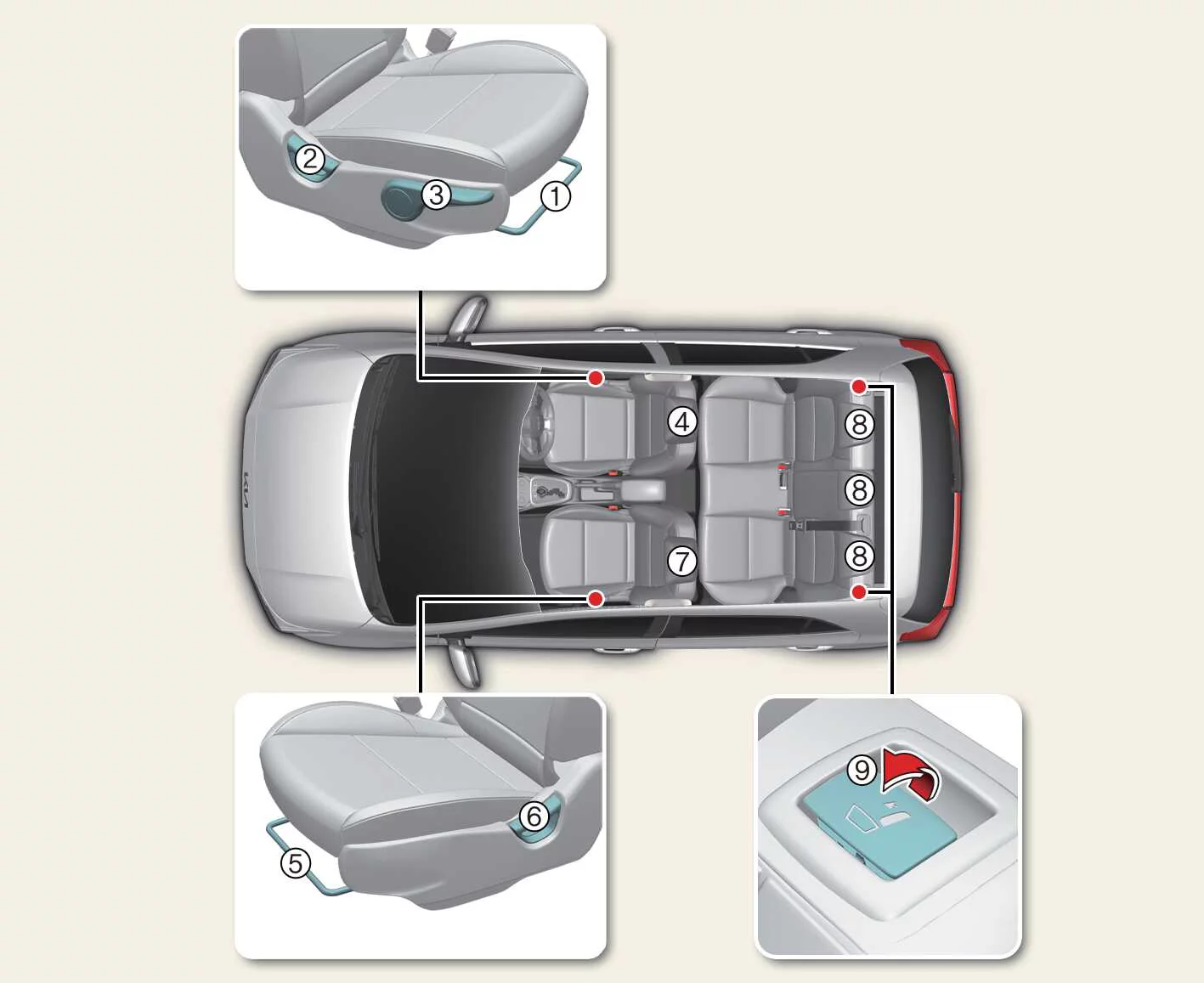
The seats and adjustment features fitted to your Kia Picanto may differ from those shown in the illustration. Use the diagram to identify the controls applicable to your vehicle.
Driver’s seat
-
Forward and backward: Adjusts the seat’s distance from the steering wheel and pedals.
-
Seatback angle: Adjusts the angle of the backrest.
-
Seat cushion height*: Adjusts the height of the seating position, where fitted.
-
Headrest: Provides headrest adjustment for the driver’s seating position.
Front passenger’s seat
-
Forward and backward: Adjusts the seat’s position along its runners.
-
Seatback angle: Adjusts the passenger backrest angle.
-
Headrest: Provides headrest adjustment for the front passenger.
Rear seat
-
Headrest*: Rear headrest equipment, where fitted.
-
Seatback folding*: Allows the rear seatback to be folded, where this feature is provided.
* If equipped. Features marked with an asterisk depend on the seating specification fitted to the vehicle.
WARNING
Loose objects
Keep the driver’s footwell clear. Loose items can move beneath the pedals and interfere with braking, acceleration or clutch operation, potentially causing an accident. Do not store objects underneath the front seats, where they may shift into the pedal area.
WARNING
Returning a seatback upright
Hold the seatback firmly and guide it slowly when returning it to the upright position. Make sure nobody is close enough to be struck by its movement. If released without control, the seatback can spring forwards and injure a nearby occupant.
WARNING
Driver responsibility for passengers
Travelling with a reclined seatback can cause serious or fatal injuries in a collision. A reclined position may allow the occupant’s hips to slide beneath the lap section of the seat belt, transferring substantial force to the unprotected abdomen and causing severe internal injuries. The driver must instruct passengers to keep their seatbacks upright whenever the vehicle is moving.
WARNING
Do not use a seating cushion that reduces friction between the occupant and the seat. During a collision or sudden stop, the occupant’s hips may slide beneath the lap belt, preventing the restraint from working correctly. The resulting force on the abdomen can cause serious or fatal internal injuries.
WARNING
Driver’s seat
-
Never adjust the seat while the vehicle is moving. Unexpected seat movement or distraction during adjustment can cause a loss of control and an accident resulting in death, serious injury or property damage.
-
Do not place anything where it can obstruct the seatback’s normal position or prevent its locking mechanism from engaging. Items stored against the backrest can interfere with secure locking and increase the risk of serious or fatal injury during a sudden stop or collision.
-
Drive and travel with the seatback upright and the lap section of the seat belt snug and low across the hips. This positioning allows the restraint to provide its intended protection in an accident.
-
Sit as far from the steering wheel as possible while retaining comfortable control of the vehicle. To reduce the risk of unnecessary or severe injury from air bag deployment, Kia recommends a distance of at least 250 mm (10 inches) between your chest and the steering wheel.
WARNING
Rear seatbacks
-
The rear seatbacks must be securely latched whenever they are upright. An unsecured backrest can allow passengers or objects to be thrown forwards during a sudden stop or collision, causing serious injury or death.
-
Place luggage and other cargo flat in the luggage compartment wherever possible. Secure items that are large, heavy or stacked, and never pile cargo above the height of the seatbacks. Unsecured or excessively high loads can cause serious or fatal injuries during sudden braking, a collision or a rollover.
-
Never allow anyone to ride in the luggage compartment or sit or lie on folded seatbacks while the vehicle is moving. Every passenger must occupy a proper seat and use the appropriate restraint throughout the journey.
-
After returning a rear seatback to its upright position, push it forwards and backwards to confirm that the latch is fully engaged.
-
Do not remove the luggage compartment carpet. Emission control components beneath the floor generate high temperatures, and the carpet helps protect against contact with surfaces that could cause burns.
WARNING
After adjusting a seat, check that it is firmly locked by trying to move it forwards and backwards without operating the release lever. An unexpected movement of the driver’s seat can affect your control of the Kia Picanto and cause an accident.
WARNING
-
Keep hands and other objects clear of the seat mechanisms while adjusting the seat. Moving components can trap or injure fingers and damage objects caught in their path.
-
Do not leave a cigarette lighter on a seat or on the floor. Seat movement can press against or damage the lighter, releasing flammable gas and creating a fire risk.
-
Take particular care when adjusting a front seat if someone is sitting behind it. Check the rear occupant’s position before moving the seat.
-
Use extreme care when retrieving small items from beneath a seat or between the seat and centre console. Sharp edges on the seat mechanism can cut or otherwise injure your hands.
CAUTION
Precautions with seat covers
-
Take care when working on the seat covering. Disturbing the associated components can cause an electrical short circuit or disconnection, potentially resulting in noise, damage to the ventilation system or fire.
-
Be mindful of wiring and ventilation openings when fitting a seat cover or covering a seat with protective plastic. Improper covering or interference with these components can cause a short circuit and create a fire risk.
Feature of Seat Leather
-
Where this upholstery is fitted, the seats use a combination of artificial and genuine leather. Genuine leather is produced from animal hide through a specialised treatment process. As a natural material, it varies in thickness and density from one area to another, and changes in temperature or humidity may cause wrinkles to appear.
-
The seat covering uses a stretchable material to improve passenger comfort and accommodate the seating contours.
-
The surfaces in contact with the occupant are shaped, while the raised side-support areas help provide comfort and stability when seated and driving.
-
Creases can develop naturally as the seats are used. This characteristic of the material does not, by itself, indicate a manufacturing fault.
CAUTION
-
Wrinkles and abrasions that develop naturally through use are not covered by the warranty.
-
Metal belt accessories, zips and keys carried in rear pockets can scratch or damage the upholstery. Check for these items before sitting down or moving across the seat surface.
-
Avoid wetting the seat. Moisture can change the properties and condition of the leather.
-
Jeans and other garments that release dye or discolour can transfer colour to the seat covering. Take care with clothing that may stain the upholstery.

 Front seat adjustment
Forward and backward
To move the front seat forwards or backwards, adjust its position along the runners as follows:
Pull the seat slide adjustment lever upwards and keep it raised..
Other information:
Ford Explorer 2020-2026 Service Manual: Diagnosis and Testing - Charging System
Diagnostic Trouble Code (DTC) Chart Diagnostics in this manual assume a certain skill level and knowledge of Ford-specific diagnostic practices. REFER to: Diagnostic Methods (100-00 General Information, Description and Operation). Diagnostic Trouble Code Chart Module DTC Description Action BCM B11DB:0..
Ford Explorer 2020-2026 Owners Manual: Audio Unit
WARNING: Driving while distracted can result in loss of vehicle control, crash and injury. We strongly recommend that you use extreme caution when using any device that may take your focus off the road. Your primary responsibility is the safe operation of your vehicle...
Categories
- Manuals Home
- 6th Generation Explorer Owners Manual
- 6th Generation Explorer Service Manual
- Removal and Installation - Front Halfshaft Speed Sensor
- Body and Paint
- Engine
- New on site
- Most important about car
Driver and Passenger Airbags
WARNING: Do not place your arms on the airbag cover or through the steering wheel. Failure to follow this instruction could result in personal injury.
WARNING: Keep the areas in front of the airbags free from obstruction. Do not affix anything to or over the airbag covers. Objects could become projectiles during airbag deployment or in a sudden stop. Failure to follow this instruction could result in personal injury or death.
WARNING: Airbags can kill or injure a child in a child restraint. Never place a rear-facing child restraint in front of an active airbag. If you must use a forward-facing child restraint in the front seat, move the seat upon which the child restraint is installed all the way back.