Kia Picanto: Air bag—supplemental restraint system / Precautions
WARNING
-
To reduce the risk of serious or fatal injury and obtain the intended protection from the restraint system in your Kia Picanto, observe all of the following precautions:
-
Never place a child in a child restraint or booster seat in the front passenger seat. Use an appropriate rear seating position for the child’s restraint.
-
A deploying front air bag can severely injure or kill an infant or child during an accident. The presence of a child seat does not remove this danger.
-
Children aged 13 and under must always travel properly restrained in the rear seat. If a child over 13 must occupy the front passenger seat, fasten the seat belt correctly and move the seat as far rearward as possible.
-
Children travelling in the rear outboard seats must be secured in a suitable Child Restraint System. Select and install the restraint correctly for the child and seating position.
-
ABC — Always Buckle Children in the back seat. The rear seat is the safest place for children of any age to travel when properly restrained.
-
Every occupant, including the driver, must always wear a seat belt, whether or not an air bag is fitted at that seating position. Correct belt use helps minimise the risk of serious injury or death across different types of crashes. Do not sit or lean unnecessarily close to an air bag while the vehicle is moving.
-
The Supplemental Restraint System (SRS) must inflate its air bags extremely quickly to provide protection in a crash. An occupant who is out of position because they are not wearing a seat belt may be struck forcefully by the deploying air bag and suffer serious or fatal injuries.
-
Front and side air bags can injure front-seat occupants who are sitting incorrectly. Maintain a proper seating position throughout the journey.
-
Position your seat as far from the front air bags as practical while retaining comfortable, effective control of the vehicle. Adjust the seat before setting off.
-
Incorrect posture or sitting out of position can lead to serious or fatal injury in a crash. Until the vehicle is parked, every occupant should remain upright, centred on the seat cushion, with the seatback upright and the seat belt properly fastened. Keep the legs comfortably extended and the feet on the floor.
-
To reduce the risk of serious or fatal injury from a deploying air bag, the driver should sit as far back from the steering wheel air bag as practical while maintaining control. The front passenger should move the seat as far rearward as possible and sit well back against the seatback.
-
Occupants in seats equipped with side and/or curtain air bags must not lean their heads or bodies against the doors, rest their arms on the doors or extend their arms through an open window. Do not place objects between an occupant and the adjacent door.
-
For the side air bag system to provide its intended protection, both front-seat occupants must sit upright with their seat belts correctly fastened. This also helps reduce the risk of injury from the deploying side air bag.
-
Do not place or attach objects over or near the air bag modules or their deployment areas around the steering wheel, instrument cluster, windscreen or front passenger panel above the glove box. Examples include instrument panel covers, mobile phone holders, cup holders, perfume containers and stickers. Such objects can cause injury during air bag deployment. Never place anything over an air bag or between yourself and an air bag.
-
Never insert or place an object in a small opening near a side air bag label on a vehicle seat. The object could interfere with deployment and cause an unexpected accident or bodily injury.
-
If you install a liquid air freshener inside the vehicle, keep its container away from the instrument cluster and off the instrument panel surface. A deploying passenger air bag could turn the container into a dangerous projectile and cause injury.
-
Keep all air bag covers and the space between each air bag and its occupant clear. Do not attach objects around deployment areas, including the doors, side windows, or front and rear pillars.
-
Do not hang heavy objects from the coat hooks. Keep these areas free of items that could endanger occupants during air bag deployment.
-
-
If the SRS air bag warning light remains illuminated while driving, have the system inspected by a professional workshop. Kia recommends visiting an authorised Kia dealer/service partner.
-
Air bags are designed for a single deployment and cannot be reused. After deployment, have the system replaced by a professional workshop. Kia recommends an authorised Kia dealer/service partner.
-
Protect all SRS components and wiring from water and other liquids. Liquid exposure can make the system inoperative and may result in fire or serious injury.
-
If the vehicle has been flooded and the carpets are soaked or water is present on the floor, do not attempt to start it. Have the vehicle inspected by a professional workshop. When cleaning air bag pad covers, use only a soft, dry cloth or a cloth lightly moistened with plain water. Solvents and cleaning products can damage the covers and interfere with correct air bag deployment.
-
Air bag inflation can itself cause injuries, including abrasions to the face or body, injuries from broken spectacles and burns. Proper seating and belt use remain essential.
-
After deployment, air bag components in the steering wheel, instrument cluster and/or roof rails above the front and rear doors can be extremely hot. To avoid injury, do not touch the internal components of these air bag storage areas immediately after inflation.
-
Front and side air bags can injure occupants who are incorrectly positioned in the front seats. Remain seated upright and properly restrained rather than leaning into an air bag deployment area.
-
There is a risk that the driver’s, front passenger’s, side and/or curtain air bags may fail to deploy, or may deploy incorrectly, during a collision if the system does not function as intended.
-
To prevent unexpected side air bag deployment and possible injury, avoid impacts to the side impact sensor while the vehicle is ON and for approximately 3 minutes after switching it OFF.
-
Do not strike, or allow objects to strike, any location where an air bag or sensor is installed. An impact in these areas can cause unexpected deployment and result in serious injury or death.
-
Changing a sensor’s installation position or angle can cause air bags to deploy unnecessarily or fail to deploy when needed, with the risk of serious or fatal injury. Do not attempt maintenance on or around the air bag sensors. Have the system serviced by a professional workshop; Kia recommends an authorised Kia dealer/service partner.
-
Do not tamper with or disconnect SRS wiring or other system components. This prohibition includes adding badges to air bag pad covers or modifying the vehicle’s body structure. Such changes can impair SRS performance and cause injury. If work is necessary, use a professional workshop. Kia recommends visiting an authorised Kia dealer/service partner.
-
Special safety procedures apply when air bag components are discarded or the vehicle is scrapped. These include the safe removal of SRS components and seat belt pre-tensioners because of the associated fire risk. Failure to follow the required precautions can increase the risk of injury. An authorised Kia dealer can explain the necessary procedures and provide guidance.
CAUTION
-
SRS components and seat belt pre-tensioners contain explosive chemicals. Scrapping a vehicle without properly removing these components can cause a fire. Before scrapping your Kia Picanto, contact a professional workshop. Kia recommends visiting an authorised Kia dealer/service partner.
-
The SRS can operate while the vehicle is ON and for approximately 3 minutes after it is switched OFF. A malfunction is indicated if the SRS air bag warning light does not illuminate when the vehicle is switched ON, remains illuminated beyond approximately 6 seconds after switch-on or starting, or comes on while driving. Have the system inspected by a professional workshop. Kia recommends an authorised Kia dealer/service partner.
-
The SRS is designed to deploy the front air bags only when an impact is sufficiently severe. Each air bag can deploy only once. Always wear your seat belt, as the air bags supplement the belts and do not replace them.
-
Front air bags are not intended to deploy in side-impact, rear-impact or rollover crashes. They also will not deploy in frontal collisions that remain below the deployment threshold.
-
Never attempt to open or repair any part of the curtain air bag system. If servicing is required, have it performed by a professional workshop. Kia recommends visiting an authorised Kia dealer/service partner.
-
Deformation of the front bumper, vehicle body or B-pillar where side collision sensors are installed can alter sensor angles and affect system operation. If these areas are damaged, have the system serviced by a professional workshop. Kia recommends an authorised Kia dealer/service partner.
-
The Kia Picanto is designed to absorb impact and deploy its air bags in certain collisions. When fitting bumper guards or replacing a bumper, use only Kia Genuine Parts or parts of an equivalent standard. Unsuitable parts can adversely affect the vehicle’s collision response and air bag deployment performance.
-
If the vehicle has side and curtain air bags, switch it OFF and wait approximately 3 minutes before towing. While the vehicle is ON, or during approximately the first 3 minutes after switch-off, these air bags may deploy if the rollover sensor interprets the vehicle’s movement or position as a rollover.
-
Deactivate the front passenger air bag only with the vehicle switched OFF. Operating the switch at another time may cause an SRS Control Module malfunction. This can create a risk that the driver’s, front passenger’s, side and/or curtain air bags will fail to deploy or will deploy incorrectly during a collision.
-
Before replacing a fuse or disconnecting a battery terminal, switch the vehicle OFF. Never remove or replace an air bag-related fuse while the vehicle is ON. Failure to follow this instruction will cause the SRS air bag warning light to illuminate.
-
Position the Child Restraint System as far from the door as possible within its approved seating position, and make sure it is securely locked in place. Follow the applicable installation instructions when positioning and securing it.
-
If the front passenger air bag ON/OFF switch malfunctions, the air bag warning light will illuminate on the instrument panel. The passenger air bag OFF indicator (
 ) will not illuminate, and the passenger air bag
ON indicator will come on instead. The SRS Control Module will reactivate the passenger air
bag, allowing it to inflate in a frontal-impact crash even when the ON/OFF switch is set to
OFF (
 ). Have the system inspected by a professional
workshop. Kia recommends visiting an authorised Kia dealer/service partner.
-
The front passenger air bag ON/OFF switch can also be turned with a similar small, rigid device. Always check both the switch position and the passenger air bag ON/OFF indicators to confirm its status. The driver is responsible for ensuring that the switch is in the correct position.
-
Switch the vehicle OFF before deactivating the front passenger air bag. Deactivating it while the vehicle is in another operating state may cause a malfunction in the SRS Control Module.
-
Do not install a Child Restraint System on the front passenger seat, even if the vehicle has a passenger air bag ON/OFF switch. Child restraints must be placed in the rear seat. Children who have outgrown an appropriate child restraint should also travel in the rear and use the available lap/shoulder belts correctly. In an accident, children receive the greatest protection when properly restrained in a suitable rear seating position.
NOTE
-
The SRS is designed to inflate the front air bags only when the detected impact is sufficiently severe. Deployment is therefore dependent on the collision conditions.
-
Front air bags are not intended to inflate in side-impact, rear-impact or rollover crashes. They will also remain undeployed in frontal collisions below the deployment threshold.
-
Side and curtain air bags deploy in certain side-impact conditions severe enough to pose a significant injury risk to occupants. Rollover deployment also applies in qualifying conditions when the vehicle is equipped with a rollover sensor.
-
If equipped with a rollover sensor
-
Where side and/or curtain air bags are fitted, they inflate rapidly when a qualifying rollover is detected to help protect occupants from serious physical injury.
-
The side and curtain air bags are designed to deploy in response to rollover detection by the rollover sensor. Whether they inflate in a particular rollover depends on the conditions detected by that sensor.
-
Although the driver’s and front passenger’s air bags are designed primarily for frontal collisions, they may also inflate in another type of collision if the front impact sensors detect sufficient force. Similarly, side and/or curtain air bags are designed for side impacts but may deploy in other collisions when the side impact sensors detect a sufficient impact. For example, the rollover sensor may identify the possibility of a rollover and trigger deployment even if the vehicle does not ultimately roll over. Deployment may also occur in other circumstances, including when the vehicle tilts during towing. Even where side and/or curtain air bags do not provide rollover impact protection, their deployment helps prevent occupants from being ejected, particularly occupants wearing seat belts. An impact to the chassis from bumps or objects on unimproved roads or pavements may also trigger an air bag. Drive carefully on rough roads and surfaces not intended for vehicle traffic to reduce the risk of unintended deployment.
-
When the front passenger air bag ON/OFF switch is set to ON, that air bag is active. Never install an infant seat or child restraint on the front passenger seat with the air bag activated.
-
-
If not equipped with a rollover sensor
-
If side and curtain air bags are fitted, they may inflate when a side-impact collision causes the vehicle to roll over. In this situation, deployment may occur in response to the side impact even though the vehicle has no rollover sensor.
-

 Overview
The air bag features available in your Kia Picanto depend on the options selected and the region in which the vehicle
is supplied. Some of the equipment described or illustrated here may therefor..
Other information:
Ford Explorer 2020-2026 Service Manual: Removal and Installation - Second Row Seat Head Restraint Guide Sleeve
Special Tool(s) / General Equipment Flat-Bladed Screwdriver Removal Second row outboard seat - Base vehicle Push the second row outboard seat head restraint release buttons. Remove the second row outboard seat head restraint...
Ford Explorer 2020-2026 Owners Manual: Using Voice Recognition
The system allows you to interact with the entertainment, information and communication systems on your vehicle using voice commands. This allows you to keep your hands on the steering wheel and focus on what is in front of you. Press the voice control button on the steering wheel and wait for the voice prompt...
Categories
- Manuals Home
- 6th Generation Explorer Owners Manual
- 6th Generation Explorer Service Manual
- Removal and Installation - All-Wheel Drive (AWD) Module
- General Procedures - Rear Camber Adjustment
- Fuel Filler Funnel Location & Running Out of Fuel
- New on site
- Most important about car
Seatbelt Height Adjustment
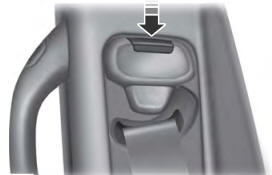
WARNING: Position the seatbelt height adjuster so that the seatbelt rests across the middle of your shoulder. Failure to adjust the seatbelt correctly could reduce its effectiveness and increase the risk of injury in a crash.