Kia Picanto: Air bag—supplemental restraint system / Overview
The air bag features available in your Kia Picanto depend on the options selected and the region in which the vehicle is supplied. Some of the equipment described or illustrated here may therefore not be fitted to your particular vehicle.
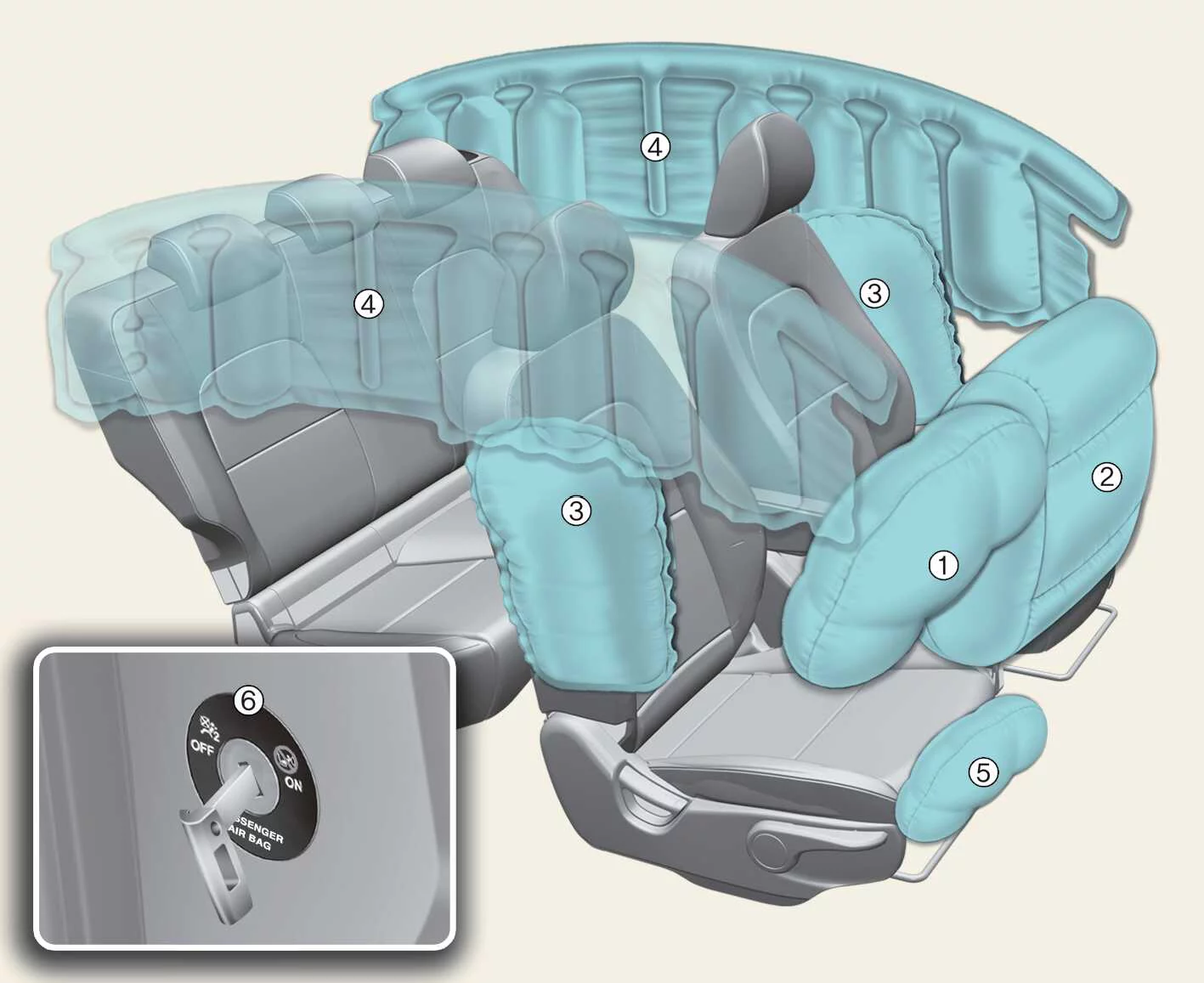
The air bags installed in your vehicle may differ from those shown in the illustration. Use the numbered guide below to identify the components represented, noting that items marked with an asterisk are available only if equipped.
-
Driver’s front air bag.
-
Front passenger’s front air bag*.
-
Side air bag*.
-
Curtain air bag*.
-
Driver’s knee air bag*.
-
Front passenger’s air bag ON/OFF switch*.
*: If equipped.
How does the air bag system operate?
-
The air bag system is active, meaning that the air bags can inflate when required, while the vehicle is in the ON position. Deployment can also occur for approximately 3 minutes after the ignition has been switched off. Switching off the ignition does not immediately eliminate the possibility of deployment.
-
Air bags inflate almost instantly during a sufficiently severe frontal collision or, where side or curtain air bags are fitted, during certain severe side collisions. Their rapid deployment helps protect occupants from serious physical injury.
-
Deployment generally depends on the severity and direction of the collision, together with the other conditions detected by the system. These factors determine whether the sensors generate the electronic signal that triggers air bag inflation.
-
The front air bags inflate fully and then deflate within an instant. This sequence happens so quickly that occupants are unlikely to see the inflation itself during an accident. After the collision, they are more likely to see the deflated air bags hanging from their storage compartments.
-
To help protect occupants in a severe collision, an air bag must inflate within the extremely short time available after impact begins. It needs to move into the space between the occupant and the vehicle’s interior structures before the occupant strikes those structures. This rapid inflation is an essential part of air bag design because it helps reduce the risk of serious or life-threatening injury during a severe crash.
-
The same rapid expansion also generates considerable force. As a result, air bag deployment can cause injuries such as facial abrasions, bruising and broken bones, even while the system is helping protect an occupant from more severe collision injuries.
-
-
In some circumstances, contact with the deploying steering wheel air bag can cause fatal injuries. The danger is particularly high when the driver is positioned excessively close to the steering wheel, making correct seating position especially important.
Noise and smoke
Air bag deployment produces a loud noise and releases smoke and fine powder into the passenger compartment. These effects are a normal result of the air bag inflator’s ignition process. After deployment, you may experience considerable breathing discomfort from the pressure of the seat belt and air bag against your chest, as well as from inhaling the smoke and powder remaining in the cabin.
Open the doors and/or windows as soon as possible after an impact to allow fresh air into the vehicle. Ventilating the passenger compartment helps reduce discomfort and limits prolonged exposure to the smoke and powder.
Although the smoke and powder are non-toxic, they can irritate exposed skin and the eyes, nose or throat. If irritation occurs, immediately wash and rinse the affected areas with cold water. Consult a doctor if the symptoms persist after rinsing.
 Precautions
WARNING
To reduce the risk of serious or fatal injury and obtain the intended protection from the restraint system in
your Kia Picanto, observe all of the following preca..
 Airbag warning and indicator light. SRS components and functions
Airbag warning and indicator light
Airbag warning light
Operating conditions
When your Kia Picanto is started, the air bag warning light should illuminate for approximately 3–6 se..
Other information:
Kia Picanto 2024-2026 Owner's Manual: Use approved window washer anti-freeze in system. Don't let your parking brake freeze
Use approved window washer anti-freeze in system Protect the windscreen washer system against freezing by adding an approved washer anti-freeze solution, following the mixing and usage instructions on its container. Suitable products are available from authorised Kia dealers or service partners and most automotive parts outlets...
Ford Explorer 2020-2026 Service Manual: Description and Operation - Body Closures - Component Location
..
Categories
- Manuals Home
- 6th Generation Explorer Owners Manual
- 6th Generation Explorer Service Manual
- Description and Operation - Jacking and Lifting - Overview
- Interior Trim and Ornamentation
- Fuel Filler Funnel Location & Running Out of Fuel
- New on site
- Most important about car
Driver and Passenger Airbags
WARNING: Do not place your arms on the airbag cover or through the steering wheel. Failure to follow this instruction could result in personal injury.
WARNING: Keep the areas in front of the airbags free from obstruction. Do not affix anything to or over the airbag covers. Objects could become projectiles during airbag deployment or in a sudden stop. Failure to follow this instruction could result in personal injury or death.
WARNING: Airbags can kill or injure a child in a child restraint. Never place a rear-facing child restraint in front of an active airbag. If you must use a forward-facing child restraint in the front seat, move the seat upon which the child restraint is installed all the way back.