
Kia Picanto: Brake system / Power brakes
Your Kia Picanto is equipped with power-assisted brakes that adjust automatically during normal use. This assistance reduces the pedal effort required when slowing or stopping the vehicle.
If brake assistance is lost because the engine stalls or for another reason, the brakes can still stop the vehicle. However, you will need to press the brake pedal harder than usual, and the stopping distance will be longer. Be prepared for both the increased pedal effort and the additional distance required.
When the engine is not running, each application of the brake pedal uses some of the remaining reserve assistance. Do not repeatedly pump the pedal after power assistance has been interrupted, as this will further reduce the available reserve.
Pumping the brake pedal should be limited to situations where it is necessary to maintain steering control on slippery surfaces and is appropriate for the braking system fitted to your vehicle.
NOTE
-
Under certain driving or weather conditions, pressing the brake pedal may produce a squeal or another temporary braking noise. Such sounds can occur during normal operation and do not necessarily indicate a brake malfunction.
-
Roads treated with de-icing chemicals may cause brake noise or unusual tyre wear. When traffic conditions allow you to do so safely, apply the brakes to help clear chemical deposits from the brake discs and pads. Carry out these additional brake applications only when they will not endanger other road users.
WARNING
Brakes
-
Do not rest your foot on the brake pedal while driving. Even sustained light pressure can produce abnormally high brake temperatures, accelerate wear of the brake linings and pads, and increase the distance needed to stop.
-
When descending a long or steep hill, select a lower gear and avoid keeping the brakes continuously applied. Prolonged braking can overheat the brakes and temporarily reduce their effectiveness. Use the lower gear to help control the vehicle’s speed throughout the descent.
-
Wet brakes can reduce your ability to slow the vehicle safely and may cause it to pull to one side during braking. Apply the brakes lightly to check whether their performance has been affected, and always make this check after driving through deep water when it is safe to do so. To dry the brakes, apply them gently while maintaining a safe forward speed until normal braking performance returns.
-
Before driving, make sure you are familiar with the positions of the brake and accelerator pedals. Confusing the two could cause you to accelerate when you intend to brake, potentially resulting in a serious accident. Confirm their positions before moving off.
In the event of brake failure
If the service brakes fail while your Kia Picanto is moving, the parking brake can be used to make an emergency stop. However, it will take considerably more distance to stop than with the service brakes operating normally, so do not expect the same stopping response.
WARNING
Parking brake
Applying the parking brake at normal driving speeds can cause a sudden loss of vehicle control. If a service brake failure makes its use necessary, exercise extreme care when applying it. The parking brake requires particular caution when used to stop a moving vehicle.
Disc brakes wear indicator: (if equipped)
Your Kia Picanto has disc brakes, with a brake pad wear indicator where equipped.
When the brake pads have worn to the point where replacement is required, a high-pitched warning sound may come from the front or rear brakes. This sound may be intermittent, appearing and disappearing during use, or it may occur each time you press the brake pedal.
CAUTION
-
Do not continue driving with worn brake pads. Replacing them when required helps prevent further brake damage and avoids potentially costly repairs.
-
Always replace brake pads in pairs across the same axle. Replace both front sets together or both rear sets together, rather than replacing pads on only one side.
WARNING
Brake wear
The brake wear warning sound signals that the braking system needs service. Do not dismiss this audible warning or postpone the required attention. Continued use of worn pads will eventually reduce braking performance and could lead to a serious accident.
NOTE
Brake dust can collect on the wheels even during everyday driving. Some dust is an unavoidable result of normal brake wear, and its accumulation can also contribute to braking noise.
Rear drum brakes: (if equipped)
If your Kia Picanto is fitted with rear drum brakes, these brakes do not have wear indicators. Have the rear brake linings inspected if you hear rubbing noises from the rear brakes, rather than waiting for a wear warning. The rear brakes should also be inspected whenever the tyres are changed or rotated and whenever the front brakes are replaced.
 Brake system
..

Other information:
Ford Explorer 2020-2026 Service Manual: Removal and Installation - Rear Heater Core Outlet Line
Removal NOTE: The rear heater core outline is installed from the factory as a one-piece assembly. The replacement part is supplied as an assembly, containing the rear heater core inlet line and the rear evaporator inlet and outlet lines. Remove the rear evaporator rear outlet and inlet line...
Ford Explorer 2020-2026 Service Manual: Removal and Installation - Sunload Sensor
Special Tool(s) / General Equipment Interior Trim Remover Removal Remove the sunload sensor from the instrument panel. Disconnect the electrical connector. Use the General Equipment: Interior Trim Remover Installation To install, reverse the removal procedure...
Categories
- Manuals Home
- 6th Generation Explorer Owners Manual
- 6th Generation Explorer Service Manual
- Electric Parking Brake
- General Service Information
- Description and Operation - Jacking and Lifting - Overview
- New on site
- Most important about car
Child Safety Locks
When these locks are set, you cannot open the rear doors from the inside.
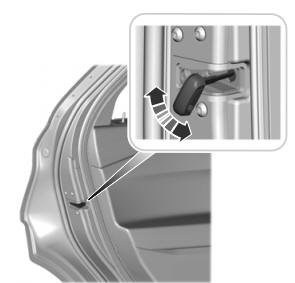
A child safety lock is on the rear edge of each rear door. You must set the child safety lock separately on each door.
Left-Hand Side
