
Kia Picanto: Child restraint system (CRS) / Our recommendation: Children always in the rear. Child Restraint System (CRS). Selecting a Child Restraint System (CRS). Child Restraint System types
Our recommendation: Children always in the rear. Child Restraint System (CRS)
WARNING
Always secure children correctly whenever they travel in the vehicle. Children of all ages are safer when properly restrained in the rear seats. Never install a rearward-facing Child Restraint System on the front passenger seat unless the passenger air bag has been deactivated. The rear seats remain the recommended location for children.
Children under the age of 13 should always travel in the rear seats and must be properly restrained on every journey. A suitable restraint helps minimise the risk of injury during an accident, a sudden stop or an unexpected manoeuvre.
Accident statistics show that children are safer when correctly restrained in the rear seats than when seated in the front. Once a child has outgrown an appropriate Child Restraint System, they must use the seat belt provided for their seating position and wear it correctly throughout the journey.
Most countries require children to travel in approved Child Restraint Systems. Make sure the restraint you use satisfies the requirements that apply wherever the vehicle is being driven.
The age, height and weight limits that determine when a child may use a seat belt instead of a Child Restraint System vary between countries. Familiarise yourself with the specific requirements in your own country and in any country you plan to visit, rather than assuming the same limits apply everywhere.
A Child Restraint System must be correctly installed and secured to the vehicle seat before use. Choose a commercially available restraint that meets your country’s requirements, and follow the relevant installation guidance for both the restraint and your Kia Picanto.
Child Restraint System (CRS)
Infants and younger children must travel in a suitable rearward-facing or forward-facing Child Restraint System that has first been securely installed on the vehicle seat. Securing the restraint to the vehicle and securing the child within the restraint are both essential. Read the manufacturer’s installation and operating instructions carefully and follow them whenever the system is fitted or used.
WARNING
-
Always follow the Child Restraint System manufacturer’s instructions for installation and use. Correct fitting is essential to the protection the restraint is designed to provide.
-
Always secure your child correctly within the Child Restraint System. A properly installed child seat cannot provide its intended protection if the child is not properly restrained inside it.
-
Do not use an infant carrier or child safety seat that simply hooks over a seatback. This type of attachment may not provide adequate protection during an accident.
-
After an accident, have the restraint system checked by a professional workshop. Kia recommends visiting an authorised Kia dealer/service partner for inspection and advice.
Selecting a Child Restraint System (CRS). Child Restraint System types
When choosing a Child Restraint System for your child, check its approval, size suitability and compatibility with the intended seating position. Always follow these selection guidelines:
-
Check that the Child Restraint System carries a certification label confirming compliance with the applicable safety standards in your country. Read the approval information before purchasing or installing the restraint.
For the installation requirements described in this manual, the Child Restraint System must be approved in accordance with ECE-R44 or ECE-R129. Its approval must also satisfy the applicable requirements where it will be used.
-
Choose a Child Restraint System suitable for your child’s height and weight. The certification label or the manufacturer’s instructions normally specify the permitted size range; check these details against your child’s current measurements.
-
Select a Child Restraint System that fits the particular vehicle seating position where you intend to install it. Suitability for the child alone does not confirm that the restraint can be installed in every seat.
Refer to the installation tables in this manual to check which Child Restraint Systems are suitable for the seating positions in your Kia Picanto.
-
Read and follow every warning and instruction supplied with the Child Restraint System, including the guidance for installation and everyday use. Keep those instructions available so that you can check the correct procedure whenever needed.
Child Restraint System types
Child Restraint Systems fall into three main categories: rearward-facing restraints, forward-facing restraints and booster seats. Each type supports and restrains a child differently as they grow.
These systems are classified according to the child’s age, height and weight. When choosing a restraint for your Kia Picanto, check the manufacturer’s stated limits to confirm that it is appropriate for your child’s current size.
Rearward-facing Child Restraint System

|
A rearward-facing Child Restraint System supports the child with the seating surface against their back. Its harness holds the child securely in position. During an accident, the restraint and harness work together to keep the child within the seat and reduce the forces acting on the vulnerable neck and spinal cord.
All children younger than one year must always travel in a rearward-facing Child Restraint System. Several designs are available: infant-only restraints are intended exclusively for rearward-facing use, while convertible and 3-in-1 restraints typically allow higher height and weight limits in the rearward-facing position. These higher limits can allow a child to continue travelling rearward-facing for longer, provided they remain within the limits specified for that particular restraint.
Continue using the rearward-facing position for as long as your child remains within the height and weight limits permitted by the Child Restraint System manufacturer. Check both limits as the child grows, and follow the instructions supplied with the restraint.
Forward-facing Child Restraint System
|
|
A forward-facing Child Restraint System uses an integrated harness to restrain the child’s body. Keep your child in a suitable forward-facing restraint with a harness until they reach the maximum height or weight permitted by its manufacturer. Check the limits for the specific restraint rather than relying on age alone.
Once your child has outgrown the permitted size range of the forward-facing Child Restraint System, the next stage is a suitable booster seat. The booster helps position the vehicle’s seat belt correctly around the growing child.
Booster seats
A booster seat is a Child Restraint System designed to improve the fit of the vehicle’s seat belt. It raises and positions the child so that the belt rests over the stronger parts of their body. Continue using a suitable booster seat until your child is large enough for the vehicle seat belt to fit correctly without it.
For a correct fit, the lap section must rest comfortably across the upper thighs rather than the stomach. The shoulder section must lie comfortably across the shoulder and chest, without crossing the neck or face. Check the position of both sections when fastening the belt. Children under the age of 13 must always be properly restrained to minimise the risk of injury during an accident, sudden stop or unexpected manoeuvre.

 Installing a Child Restraint System (CRS)
WARNING
Before installing a Child Restraint System in your Kia Picanto, always complete the following preparation:
Read the installation and operating instructions supplied by the Child Restraint Sy..
Other information:
Ford Explorer 2020-2026 Service Manual: Removal and Installation - Rear Door Upper Moulding
Removal NOTE: Removal steps in this procedure may contain installation details. NOTE: LH side shown, RH side similar. Remove the upper belt moulding screw at front of the door. Torque: 12 lb.in (1.3 Nm) Lift the moulding at the front edge using a non-marring trim tool and slide forward to disengage from the tab at the rear and remove th..
Ford Explorer 2020-2026 Service Manual: General Procedures - Transmission Line Pressure Test
Materials Name Specification Motorcraft® MERCON® ULV Automatic Transmission FluidXT-12-QULV WSS-M2C949-A, MERCON® ULV Check With the vehicle in NEUTRAL, position it on a hoist. Refer to: Jacking and Lifting - Overview (100-02 Jacking and Lifting, Description and Operation)...
Categories
- Manuals Home
- 6th Generation Explorer Owners Manual
- 6th Generation Explorer Service Manual
- Automatic Transmission
- Engine - 2.3L EcoBoost (201kW/273PS)
- Automatic Transmission - 10-Speed Automatic Transmission – 10R60
- New on site
- Most important about car
Gauges
4 Inch Display
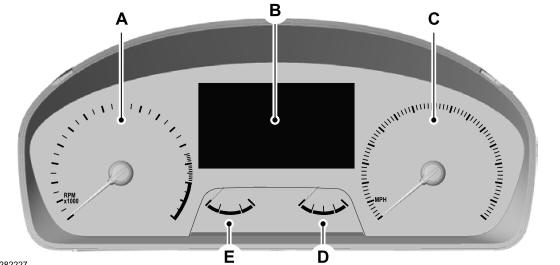
A - Tachometer.
B - Information display.
C - Speedometer.
D - Fuel gauge.
E - Engine coolant temperature gauge.
