Kia Picanto: Seat belt warning / Lap/Shoulder belt
Height adjustment (front seat): (if equipped)
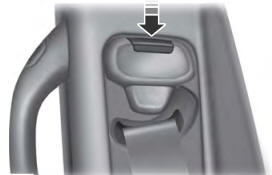
The front shoulder belt anchor can be adjusted to one of three height positions. Select the position that provides a comfortable fit while keeping the belt correctly aligned with your shoulder.
The shoulder section should cross your chest and pass midway over the shoulder nearest the door. It must not rest against your neck or sit so high that it crosses your face.
Raise or lower the anchor using the height adjuster until the belt follows the correct path across your upper body.
To raise the adjuster, pull it upwards (1). To lower it, press and hold the adjustment button (2) while pushing the adjuster downwards (3).
|
Figure 1. Front seat 
|
Release the button to secure the anchor, then try sliding the adjuster to confirm that it has locked into position. Check the belt’s fit again from your normal seating position.
An incorrectly positioned seat belt can cause serious injuries in a collision, even when the buckle is fastened.
WARNING
-
Confirm that the shoulder belt anchor is securely locked at a suitable height. Never position the shoulder section across your neck or face.
-
After a collision, have the seat belt system inspected to confirm that it operates correctly. Replace any belt that no longer functions as intended.
To fasten your seat belt:
Pull the belt from its retractor and insert the metal tongue (1) into the appropriate buckle (2). Listen for the click that confirms the tongue has engaged in the buckle.
First position the lap section manually so that it sits snugly around your hips; the retractor then adjusts the remaining belt length. Slow, gentle forward movement allows the belt to extend. A sudden stop or impact causes it to lock, and it will also lock if you lean forwards too quickly.
|
|
|
NOTE
If the belt will not extend from the retractor, give it a firm pull and then release it. After the mechanism releases, draw the belt out again with a smooth, steady movement.
|
|
WARNING
Keep the lap section as low and snug as possible across your hips, not around your waist. A belt positioned too high increases the risk of injury during a collision. Position your arms as illustrated, with the shoulder section passing over the shoulder nearest the door and across the chest; do not place both arms above or beneath the belt.
Never route the shoulder belt under the arm nearest the door. It must remain over that shoulder to restrain your upper body correctly.
|
|
Each belt must be fastened into the buckle assigned to its seating position. Identify the correct buckle before inserting the tongue, particularly when using the rear seats of your Kia Picanto.
-
Right rear: Use the buckle assigned to the right rear seat belt.
-
Centre rear: Use the buckle assigned to the centre rear seat belt.
-
Left rear: Use the buckle assigned to the left rear seat belt.
|
For the rear centre seating position, always use the buckle marked CENTER. Do not substitute a buckle belonging to an adjacent seat.
Rear centre seatbelt:
Keep the connector plate (1) and its buckle (2) engaged. Pull out the fastening tongue (3) and insert it into the occupant buckle (4) until it clicks into place. Check that the webbing lies flat and is not twisted along its path.
Always fasten the rear centre belt into the buckle carrying the CENTER marking.
|
|
|
To release the seat belt:
Press the release button (1) on the fastening buckle to disengage the tongue. The belt should then retract automatically into its housing.
If it does not retract, check the webbing for twists, straighten it as necessary and try again.
|
|
 Driver’s seat belt warning . Front passenger’s seat belt warning: (if equipped)
Driver’s seat belt warning
Each time the ignition switch or ENGINE START/STOP button is switched ON, the
driver’s seat belt warning light illuminates for approximately six seconds, w..
 Lap belt: (if equipped). Stowing the rear seat belt
Lap belt: (if equipped)
To fasten your seat belt:
Insert the metal tongue (1) of the two-point static lap belt into its locking buckle (2). An audible click confirms
engagement...
Other information:
Ford Explorer 2020-2026 Service Manual: Removal and Installation - Engine Oil Pressure (EOP) Sensor
Removal NOTE: Removal steps in this procedure may contain installation details. NOTE: During engine repair procedures, cleanliness is extremely important. Any foreign material (including any material created while cleaning gasket surfaces) that enters the oil passages, coolant passages or the oil pan can cause engine failure...
Kia Picanto 2024-2026 Owner's Manual: Vehicle identification number (VIN). Vehicle certification label
Vehicle identification number (VIN) The vehicle identification number, usually abbreviated to VIN, identifies your Kia Picanto for vehicle registration and legal matters relating to ownership...
Categories
- Manuals Home
- 6th Generation Explorer Owners Manual
- 6th Generation Explorer Service Manual
- General Procedures - Transmission Fluid Drain and Refill
- Description and Operation - Jacking and Lifting - Overview
- Description and Operation - Identification Codes
- New on site
- Most important about car
Seatbelt Height Adjustment
WARNING: Position the seatbelt height adjuster so that the seatbelt rests across the middle of your shoulder. Failure to adjust the seatbelt correctly could reduce its effectiveness and increase the risk of injury in a crash.