Kia Picanto: Maintenance / Engine Coolant
The Kia Picanto’s high-pressure cooling system has a reservoir that is filled at the factory with coolant containing antifreeze for year-round use. Check the coolant level and antifreeze protection at least once a year, before winter begins, and before travelling to a colder climate.
-
If the engine overheats because the coolant level is low, adding a large amount of coolant at once may crack the engine. To reduce the risk of damage, add coolant slowly and in small amounts.
-
Do not drive without engine coolant. Operating the vehicle with no coolant can cause water-pump failure, engine seizure and other damage.
Checking the Coolant Level. Recommended Engine Coolant
Warning

Removing the radiator cap
-
Never remove the radiator cap while the engine is running or hot. Doing so can damage the cooling system or engine, and escaping hot coolant or steam can cause serious injury.
-
Switch off the engine and wait until it has cooled. Use extreme care when removing the radiator cap. Cover it with a thick towel and turn it counterclockwise slowly until it reaches the first stop. Move back while pressure escapes from the cooling system.
After the pressure has fully dissipated, press down on the cap through the towel and continue turning it counterclockwise to remove it.
-
The engine and radiator can remain hot and pressurised even after the engine has been switched off. Do not remove the radiator cap or drain plug while they are hot; escaping coolant or steam may cause serious injury.
Warning

The electric cooling fan is controlled by coolant temperature, refrigerant pressure and vehicle speed. It may start even when the engine is off. Keep clear of the fan blades whenever you work near them, as a rotating fan can cause injury. The fan switches off automatically as the coolant temperature falls; this is normal.
Inspect the cooling-system and heater hoses, including their connections. Replace any hose that is swollen or deteriorated.
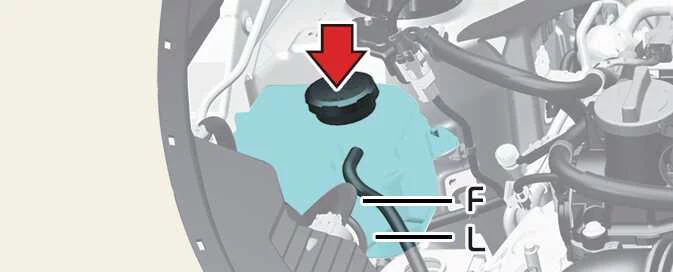
When the engine is cool, the coolant level in the reservoir should be between the MAX and MIN marks (or F and L) on its side. If the level is low, add distilled (deionized) or soft water until it reaches the MAX (F) mark. Do not overfill the reservoir.
If the coolant needs topping up frequently, have the cooling system inspected by a qualified workshop. Kia recommends contacting an authorised Kia dealer or service partner.
Recommended Engine Coolant
-
When topping up the Kia Picanto coolant, use only deionized or soft water. Do not mix hard water with the coolant installed at the factory. An incorrect mixture can cause a serious malfunction or engine damage.
-
The engine contains aluminium components and must be protected with an ethylene-glycol coolant with a phosphate base to help prevent corrosion and freezing.
-
Do not use alcohol or methanol coolant, and do not mix either type with the specified coolant.
-
Do not use a mixture containing more than 60% antifreeze or less than 35% antifreeze, as either concentration reduces the mixture’s effectiveness.
Use the following antifreeze-to-water proportions as a guide for the indicated ambient temperatures.
|
Ambient temperature |
Mixture percentage by volume |
|
|---|---|---|
|
Antifreeze |
Water |
|
|
-15°C (5°F) |
35% |
65% |
|
-25°C (-13°F) |
40% |
60% |
|
-35°C (-31°F) |
50% |
50% |
|
-45°C (-49°F) |
60% |
40% |
Warning
Radiator cap
Do not remove the radiator cap while the engine or radiator is hot. Scalding coolant or steam may escape under pressure and cause serious injury.
Changing the Coolant
Have the coolant replaced by a qualified workshop. Kia recommends using an authorised Kia dealer or service partner.
Caution
Before refilling the coolant, place a thick cloth around the radiator cap. This helps prevent coolant from spilling onto engine components such as the alternator.
Warning
Coolant
-
Do not put radiator coolant or antifreeze in the windscreen-washer fluid reservoir.
-
If sprayed onto the windscreen, radiator coolant can severely reduce visibility and may cause loss of vehicle control. It can also damage the paint and body trim.
 Engine Oil
Checking the Engine Oil Level
Engine oil lubricates moving parts, helps cool the engine and operates various hydraulic components. Some oil
consumption while driving is normal, so check the leve..
 Brake and Clutch Fluid. Checking the Brake and Clutch Fluid Level. Automatic Transmission Fluid
Brake and Clutch Fluid (If Equipped). Checking the Brake and Clutch Fluid Level
Checking the Brake and Clutch Fluid Level
Figure 1...
Other information:
Kia Picanto 2024-2026 Owner's Manual: Theft-alarm system: (if equipped)
A Kia Picanto equipped with the theft-alarm system carries a security label displaying the following wording. The label identifies the presence of the vehicle’s security system. WARNING SECURITY SYSTEM ..
Ford Explorer 2020-2026 Service Manual: Description and Operation - Steering Column - Overview
Steering Column Overview The steering column system consists of the following components: Steering wheel SCCM Telescopic and tilt motors (power adjustable steering column) Steering column control switch (power adjustable steering column) The steering column is the mechanical linkage between the steering wheel and the steering gear...
Categories
- Manuals Home
- 6th Generation Explorer Owners Manual
- 6th Generation Explorer Service Manual
- Interior Trim and Ornamentation
- Electric Parking Brake
- Body and Paint
- New on site
- Most important about car
Intelligent Access Key
Note: You may not be able to shift out of park (P) unless the intelligent access key is inside your vehicle.