Kia Picanto: Towing / Emergency towing. Emergency towing precautions
|
Figure 1. Front 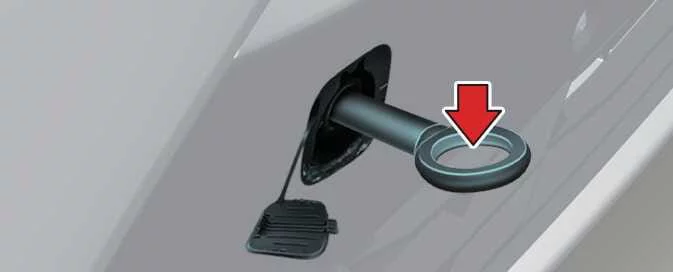
|
Figure 2. Rear 
|
If the Kia Picanto needs to be towed, Kia recommends using an authorised Kia dealer or a commercial towing service.
If professional towing is unavailable during an emergency, the vehicle may be towed temporarily using a cable or chain attached to the emergency towing hook at the front or rear. Use extreme care. A driver must remain in the towed vehicle to steer and operate the brakes.
This method is suitable only for short distances at low speeds on hard-surfaced roads. The wheels, axles, powertrain, steering and brakes must all be in good condition before towing.
-
Do not use the towing hooks to pull the vehicle out of mud, sand or any other surface from which it cannot drive away under its own power.
-
Do not tow a vehicle that is heavier than the towing vehicle.
-
The drivers of both vehicles should communicate with each other frequently throughout the towing process.
CAUTION
-
Attach the towing strap to the designated towing hook.
-
Using any part of the vehicle other than the towing hooks may damage the body.
-
Use only a cable or chain designed specifically for vehicle towing, and fasten it securely to the supplied towing hook.
-
When starting or moving the vehicle, accelerate and decelerate slowly and smoothly, keeping the towing cable or chain taut. Sudden force may damage the towing hooks or the vehicle.
-
-
Before towing, check that the hook is not broken or damaged.
-
Fasten the towing cable or chain securely to the hook.
-
Do not jerk the hook. Apply force steadily and evenly.
-
To avoid damaging the hook, do not pull sideways or at an upward or downward angle. Keep the pull straight ahead.
WARNING
Use extreme caution when towing the Kia Picanto.
-
Avoid sudden starts and erratic driving that could place excessive strain on the emergency towing hook, cable or chain. These components may break and cause serious injury or vehicle damage.
-
If the disabled vehicle cannot be moved, do not continue towing by force. Contact an authorised Kia dealer or commercial towing service for assistance.
-
Keep the towing vehicle and the towed vehicle aligned as straight as possible.
-
Keep a safe distance from the vehicles while towing.
-
Use a towing strap shorter than 5 m (16 ft). For visibility, attach a white or red cloth about 30 cm (12 in) wide to the middle of the strap.
-
Drive carefully and keep the towing strap from becoming slack while the vehicles are moving.
-
The driver must remain in the towed vehicle to steer and brake. Do not allow any passengers to ride in it.
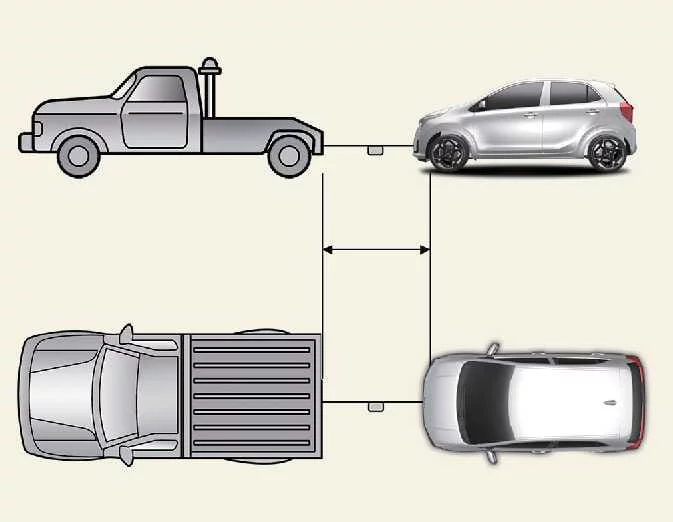
Emergency towing precautions
-
Turn the ignition switch to ACC so the steering wheel remains unlocked.
-
Move the transmission shift lever to N (Neutral).
-
Release the parking brake.
-
Press the brake pedal with more force than usual because braking performance will be reduced.
-
Steering will require more effort because the power steering system will not operate.
-
If towing downhill over a long distance, the brakes may overheat and braking performance may decrease. Stop regularly and allow the brakes to cool.
-
Tow the vehicle at no more than 25 km/h (15 mph) and for no more than 20 km (12 miles).
CAUTION
Automatic transmission
-
If the vehicle is towed with all four wheels on the ground, it must be towed from the front only. Make sure the transmission is in N (Neutral) and the steering is unlocked by turning the ignition switch to ACC. A driver must remain in the towed vehicle to operate the steering and brakes.
-
To prevent serious damage to the automatic transmission, do not exceed 15 km/h (10 mph) and keep the towing distance below 1.5 km (1 mile).
-
Before towing, check beneath the vehicle for automatic transmission fluid leaks. If fluid is leaking, use a flatbed tow truck or towing dolly.
 Towing service. Removable towing hook
Towing service
Wheel dollies
..
 Emergency Commodity
The Kia Picanto may be supplied with emergency equipment to help you respond to unexpected situations on the road. Check what is available in your vehicle and familiarise yourself with its locatio..
Other information:
Ford Explorer 2020-2026 Service Manual: Removal and Installation - Front Bumper Cover
Special Tool(s) / General Equipment Interior Trim Remover Removal NOTE: Removal steps in this procedure may contain installation details. Remove the front wheels and tires. Refer to: Wheel and Tire (204-04A Wheels and Tires, Removal and Installation)...
Ford Explorer 2020-2026 Service Manual: Removal and Installation - Rear Stabilizer Bar Link
Removal NOTICE: Suspension fasteners are critical parts that affect the performance of vital components and systems. Failure of these fasteners may result in major service expense. Use the same or equivalent parts if replacement is necessary. Do not use a replacement part of lesser quality or substitute design...
Categories
- Manuals Home
- 6th Generation Explorer Owners Manual
- 6th Generation Explorer Service Manual
- Body and Paint
- Engine
- Traction Control
- New on site
- Most important about car
Fastening the Seatbelts
The front outboard and rear safety restraints in the vehicle are combination lap and shoulder belts.