
Ford Explorer: Rear Suspension / Description and Operation - Rear Suspension - Overview
Ford Explorer 2020-2026 Service Manual / Chassis / Suspension / Rear Suspension / Description and Operation - Rear Suspension - Overview
Overview
The rear suspension consists of the following components:
- Coil springs
- Lower arm and bushing assemblies
- Stabilizer bar and links
- Toe links
- Upper arms
- Lower arm vertical links
- Wheel bearing and wheel hub assemblies
- Wheel knuckles
- Wheel studs
- Suspension height sensor
- Dynamically controlled shock absorbers
The rear suspension uses 2 parallel arms (1 upper and 1 lower). Each arm has a mounting position to the chassis and an attachment at the wheel knuckle. This suspension allows the wheels to react to road imperfections independent of each other. The shock absorber mounts to the whel knuckle and along with the spring, controls vertical movement. The stabilizer bar and links control suspension lean/sway.

 Removal and Installation - Lower Arm
Special Tool(s) /
General Equipment
Vehicle/Axle Stands
Removal
NOTICE:
Suspension fasteners are critical parts that affect the
performance of vital components and systems...
Other information:
Ford Explorer 2020-2026 Service Manual: Description and Operation - Rear Drive Axle and Differential
The 8.1-inch and 8.8-inch ring gear open rear differential axle has 3.31, 3.58, and 3.73 gear ratio versions. Rear Drive Axle and Differential The rear axle assembly consists of the following: Integral-type housing hypoid gear design (center of the pinion set below the centerline of the ring gear) Hypoid differential ring gear and pinion consisting of a 8...
Ford Explorer 2020-2026 Service Manual: Diagnosis and Testing - Turn Signal and Hazard Lamps
Diagnostic Trouble Code (DTC) Chart Diagnostics in this manual assume a certain skill level and knowledge of Ford-specific diagnostic practices. REFER to: Diagnostic Methods (100-00 General Information, Description and Operation). Diagnostic Trouble Code Chart Module DTC Description Action BCM B123A:1..
Categories
- Manuals Home
- 6th Generation Explorer Owners Manual
- 6th Generation Explorer Service Manual
- Body and Paint
- General Procedures - Brake Service Mode Activation and Deactivation
- Removal and Installation - All-Wheel Drive (AWD) Module
- New on site
- Most important about car
Gauges
4 Inch Display
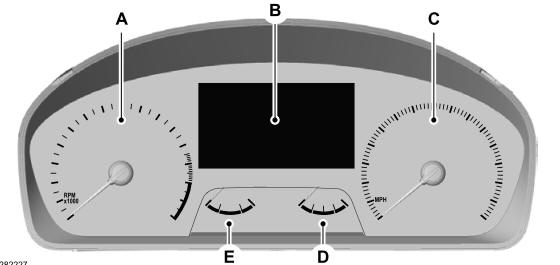
A - Tachometer.
B - Information display.
C - Speedometer.
D - Fuel gauge.
E - Engine coolant temperature gauge.

Copyright © 2026 www.foexplorer.com