Kia Picanto: Tyres and Wheels / Tyre Maintenance. Tyre Sidewall Markings
Tyre Maintenance
Correct wheel alignment, along with proper inflation, helps limit tyre wear. If you notice uneven wear, have the wheel alignment checked by a qualified workshop. Kia recommends contacting an authorised Kia dealer or service partner.
Have new tyres balanced when they are installed to improve ride comfort and help extend tyre life. A tyre must also be rebalanced whenever it is removed from its wheel.
Tyre Sidewall Markings
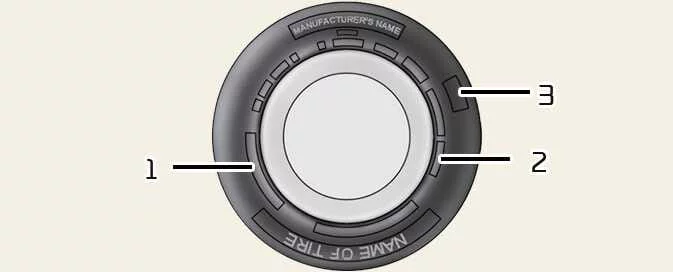
Tyre sidewall markings identify the tyre’s main characteristics and include its Tyre Identification Number (TIN), which certifies compliance with safety standards and can help identify the tyre if it is recalled.
1. Manufacturer or brand name
The tyre sidewall displays the manufacturer’s name or brand.
2. Tyre size designation
The tyre size is marked on its sidewall. Check this designation when selecting replacement tyres for your Kia Picanto. The example below explains what its letters and numbers mean; the size fitted to your vehicle may be different.
Example tyre size: P235/55R19 108T
P: Vehicle type. Tyres with a “P” prefix are intended for passenger vehicles or light trucks, although not all tyres carry this prefix.
235: Tyre width in millimetres.
55: Aspect ratio—the tyre’s section height expressed as a percentage of its width.
R: Radial construction.
19: Rim diameter in inches.
108: Load index, a numerical code associated with the maximum load the tyre can carry.
T: Speed-rating symbol. Refer to the speed-rating chart below for its maximum speed.
Wheel size designation
Wheels also carry markings needed when choosing a replacement. The example below explains the figures and letter in a wheel-size designation.
Example wheel size: 7.5J × 19
7.5: Rim width in inches.
J: Rim contour designation.
19: Rim diameter in inches.
Tyre speed ratings
The speed-rating symbol is part of the tyre-size designation on the sidewall. It indicates the tyre’s designed maximum operating speed. The chart lists several ratings used for passenger-car tyres.
|
Speed-rating symbol |
Maximum speed |
|---|---|
|
S |
180 km/h (112 mph) |
|
T |
190 km/h (118 mph) |
|
H |
210 km/h (130 mph) |
|
V |
240 km/h (149 mph) |
|
W |
270 km/h (168 mph) |
|
Y |
300 km/h (186 mph) |
3. Checking tyre age (TIN: Tyre Identification Number)
Tyres more than six years old, based on their manufacturing date, should be replaced, including the spare tyre. The manufacturing date is part of the DOT code on the tyre sidewall and may be on the inner side of the wheel. The DOT code contains numbers and English letters; its final four digits identify the week and year of manufacture.
DOT: XXXX XXXX OOOO
The first part of the DOT code identifies the plant, tyre size and tread pattern. The last four digits show the production week and year.
For example, DOT XXXX XXXX 1626 indicates that the tyre was manufactured in the 16th week of 2026.
Warning
Tyre age
Tyres deteriorate over time, even when they are not being used.
Regardless of the remaining tread, Kia recommends replacing tyres after approximately six years of normal service. High temperatures or frequent heavy loading can accelerate tyre ageing. Ignoring this warning may lead to sudden tyre failure, loss of vehicle control and an accident causing serious injury or death.
4. Tyre ply composition and materials
The sidewall identifies the number of layers, or plies, of rubber-coated fabric in the tyre and the materials used, which may include steel, nylon or polyester. R indicates radial-ply construction, D indicates diagonal or bias-ply construction, and B indicates belted-bias-ply construction.
5. Maximum permissible inflation pressure
This marking gives the highest air pressure that may be used in the tyre. Do not exceed it. Use the tyre and loading information label to find the recommended inflation pressure for your Kia Picanto.
6. Maximum load rating
This marking shows the maximum load the tyre can carry, in kilograms and pounds. When replacing a tyre, choose one with at least the same load rating as the tyre originally fitted to the vehicle.
7. Uniform tyre quality grading
Where applicable, quality grades appear on the tyre sidewall between the tread shoulder and the maximum section width.
Example: TREADWEAR 200 TRACTION AA TEMPERATURE A
Treadwear
The treadwear grade compares a tyre’s wear rate with that of other tyres in controlled tests on a specified government test course. For example, a tyre graded 150 is expected to last one and a half times as long as a tyre graded 100 under those test conditions.
Actual tyre life depends on how and where the tyres are used. Driving habits, maintenance practices, road surfaces and climate can all cause real-world results to differ significantly from the test comparison.
These grades are moulded into the sidewalls of passenger-vehicle tyres. The tyres supplied as standard or optional equipment for your Kia Picanto may have different grades.
Traction — AA, A, B and C
Traction grades, from highest to lowest, are AA, A, B and C. They indicate a tyre’s ability to stop on wet pavement, measured under controlled conditions on specified government test surfaces made of asphalt and concrete. A tyre marked C may have poor traction performance.
Temperature — A, B and C
Temperature grades are A, B and C, with A the highest. They indicate a tyre’s resistance to heat build-up and its ability to dissipate heat in controlled tests using a specified indoor laboratory test wheel.
Prolonged high temperatures can cause tyre materials to deteriorate and shorten tyre life. Excessive heat may lead to sudden tyre failure. Grades B and A indicate performance on the laboratory test wheel above the minimum required by law.
Warning
The traction grade is based on straight-line braking tests. It does not measure acceleration, cornering, resistance to hydroplaning or peak traction.
Warning
Tyre temperature
The temperature grade applies to a tyre that is correctly inflated and not overloaded. Excessive speed, underinflation or overloading—alone or in combination—can cause heat build-up and sudden tyre failure. This may result in loss of vehicle control, serious injury or death.
 Wheel Replacement. Tyre Traction
Wheel Replacement
If you replace a metal wheel, choose one equivalent to the original factory wheel in diameter, rim width and offset.
Warning
A wheel of the wrong size can affect wheel and bearin..
 Low-Aspect-Ratio Tyres (If Equipped)
Low-aspect-ratio tyres have an aspect ratio below 50 and give the Kia Picanto a sportier appearance.
These tyres are designed to support handling and braking performance...
Other information:
Ford Explorer 2020-2026 Service Manual: Description and Operation - Information and Entertainment System - System Operation and Component Description
System Operation System Diagram NOTE: The system diagrams include all component options. Some components may not be equipped on the vehicle. Audio System - 4 or 6 Speaker System Item Description 1 APIM 2 Audio Unit Antenna Amplifier 3 Steering Wheel Switches 4 Display Unit 5 SCCM 6 Clockspring 7 GWM 8 BCM ..
Ford Explorer 2020-2026 Service Manual: Removal and Installation - Engine Coolant Temperature (ECT) Sensor
Removal NOTE: Removal steps in this procedure may contain installation details. Remove the EGR cooler. Refer to: Exhaust Gas Recirculation (EGR) Cooler (303-08A Engine Emission Control - 2.3L EcoBoost (201kW/273PS), Removal and Installation)...
Categories
- Manuals Home
- 6th Generation Explorer Owners Manual
- 6th Generation Explorer Service Manual
- Description and Operation - Identification Codes
- Engine - 2.3L EcoBoost (201kW/273PS)
- Engine
- New on site
- Most important about car
Children and Airbags
WARNING: Airbags can kill or injure a child in a child restraint. Never place a rear-facing child restraint in front of an active airbag. If you must use a forward-facing child restraint in the front seat, move the seat upon which the child restraint is installed all the way back.