
Kia Picanto: Seat belts / Seat belt restraint system
WARNING
-
Every occupant must wear a seat belt whenever the vehicle is moving. Consistent, correct use is essential for obtaining the protection provided by the Kia Picanto restraint system.
-
Seat belts provide their most effective protection when the seatbacks are upright. Set the backrest correctly before fastening the belt and beginning the journey.
-
Children aged 13 and younger must always travel properly restrained in the rear seat. Do not allow them to ride in the front passenger seat. If a child older than 13 must occupy the front passenger seat, ensure the seat belt is correctly fastened and move the seat as far rearwards as possible.
-
Never route the shoulder belt beneath your arm or behind your back. Incorrect positioning can cause serious injuries in a collision. The shoulder section should pass across the collarbone, approximately midway over the shoulder.
-
Do not wear a seat belt over fragile objects. During a sudden stop or impact, pressure from the belt can crush or break items trapped beneath it.
-
Keep the belt webbing flat and untwisted. A twisted belt cannot distribute restraint forces as intended and may cut into the occupant during a collision. Check the full visible length before travelling.
-
Protect the webbing, buckle and other belt hardware from damage. If any part of the webbing or hardware is damaged, have the affected restraint replaced.
WARNING
Seat belts are designed to restrain the body through its bony structures. Position the lap section low across the front of the pelvis; where a shoulder section is provided, it should pass across the chest and shoulder. Never position the lap belt across the abdomen, where restraint forces can cause serious injury.
Adjust the belt as snugly as comfort allows. A correctly fitted belt should hold the occupant securely without unnecessary looseness, allowing it to provide its intended protection.
Slack in the webbing substantially reduces the belt’s effectiveness. Remove excess slack when fastening the belt rather than leaving it loose around the body.
Keep the webbing free from polish, oil and chemicals, particularly battery acid. Contamination can affect the condition of the restraint and must be avoided.
Use mild soap and water to clean the belt safely. Replace the belt if its webbing becomes frayed, contaminated or otherwise damaged.
A seat belt worn during a severe impact must be replaced as a complete assembly, even if no damage is visible. Never use a belt with twisted straps, and never share one belt between two occupants. Placing a belt around both an adult and a child sitting on the adult’s lap is dangerous; each restraint assembly is intended for one person only.
WARNING
-
Do not modify the seat belt or add anything that interferes with its adjustment mechanism. The belt and its adjusting devices must remain able to remove slack and fit securely around the occupant.
-
Fasten the belt only into the buckle assigned to that seating position. Using another seat’s buckle can create an unsafe belt arrangement and prevent the restraint from protecting you correctly.
-
Do not release your seat belt while driving, and never repeatedly fasten and unfasten it while the vehicle is moving. These actions can distract you, cause a loss of control and lead to an accident involving death, serious injury or property damage.
-
Before fastening the belt, check that no hard or easily broken objects lie between the webbing and your body. Remove or reposition such items so the belt rests correctly against you.
-
Make sure the buckle is clear of foreign objects. Anything lodged inside it can prevent the latch from engaging securely, even if the belt appears to be fastened.
 Seat belts
..

Other information:
Ford Explorer 2020-2026 Service Manual: Diagnosis and Testing - Interior Lighting
Diagnostic Trouble Code (DTC) Chart Diagnostics in this manual assume a certain skill level and knowledge of Ford-specific diagnostic practices. REFER to: Diagnostic Methods (100-00 General Information, Description and Operation). Diagnostic Trouble Code Chart Module DTC Description Action BCM B1175:0..
Ford Explorer 2020-2026 Service Manual: Removal and Installation - Exterior Front Door Handle
Removal NOTE: LH (left-hand) side shown, RH (right-hand) side similar. NOTE: Removal steps in this procedure may contain installation details. Vehicles with passive entry Remove the front door window regulator and motor. Refer to: Front Door Window Regulator and Motor (501-11 Glass, Frames and Mechanisms, Removal and Installation)...
Categories
- Manuals Home
- 6th Generation Explorer Owners Manual
- 6th Generation Explorer Service Manual
- Driveline
- Automatic Transmission - 10-Speed Automatic Transmission – 10R60
- Engine - 2.3L EcoBoost (201kW/273PS)
- New on site
- Most important about car
Windshield Wipers
 Push the lever up or down to operate
the windshield wipers.
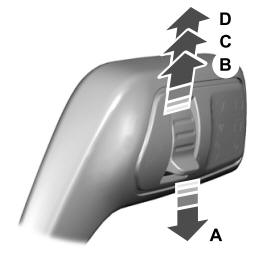
A - Single wipe.
