Kia Picanto: What to do in an emergency / If the engine will not start. Emergency starting
If the engine will not start
If the engine does not turn over or turns over slowly
-
If your Kia Picanto has an automatic transmission, make sure the shift lever is in N (Neutral) or P (Park), and check that the emergency brake is applied.
-
Check that the battery connections are clean and securely attached.
-
Switch on the interior light. If it dims or goes out when you operate the starter, the battery may be discharged.
-
Check that the starter connections are securely tightened.
-
Do not try to start the vehicle by pushing or pulling it. Refer to the jump-starting instructions instead.
WARNING
Never push or pull the vehicle to start the engine. This may cause a collision or other damage, overload the catalytic converter or create a fire hazard.
If the engine turns over normally but does not start
-
Check the fuel level.
-
With the ignition in LOCK, inspect the ignition coil and spark plug connectors. Reconnect any loose or disconnected connectors.
-
Check the fuel line in the engine compartment.
-
If the engine still will not start, contact a professional workshop. Kia recommends visiting an authorised Kia dealer or service partner.
Emergency starting
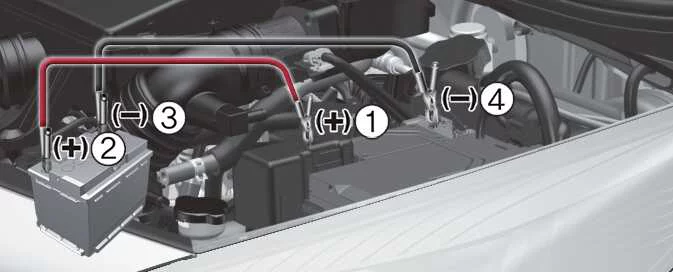
When jump-starting the Kia Picanto, connect the cables in the numbered order shown and disconnect them in the reverse order. Follow the correct sequence when attaching and removing the cables.
 |
Jump starting. Jump starting procedure
Jump starting can be hazardous if the cables are connected incorrectly. To protect yourself and prevent damage to the Kia Picanto or its battery, follow the procedure below carefully. If you are unsure about any step, ask a qualified technician or roadside assistance service to jump start the vehicle.
CAUTION
Use only a 12-volt jump-starting system. A 24-volt power supply, such as two 12-volt batteries connected in series or a 24-volt motor-generator set, can cause irreparable damage to the starter motor, ignition system and other electrical components.
WARNING
Battery
Never check the battery electrolyte level. The battery could rupture or explode, causing serious injury.
WARNING
Battery
-
Keep flames and sparks away from the battery. It produces hydrogen gas, which can explode if exposed to an ignition source.
Follow the jump-starting instructions precisely to avoid serious injury or damage to the vehicle. If you are uncertain how to carry out the procedure, seek qualified assistance. Automotive batteries contain poisonous, highly corrosive sulfuric acid. Wear protective glasses while jump starting, and take care to keep acid off your skin, clothing and the vehicle.
-
Do not attempt to jump start the vehicle if the discharged battery is frozen or its electrolyte level is low. The battery may rupture or explode.
-
Do not let the positive (+) and negative (−) jumper cables touch each other, as this can create sparks.
-
A low or frozen battery may rupture or explode during a jump start.
Jump starting procedure
-
Check that the booster battery is 12 volts and that its negative terminal is grounded.
-
If the booster battery is in another vehicle, position the vehicles so they do not touch.
-
Switch off all electrical equipment that is not needed for the jump start.
-
Connect the jumper cables in the exact order shown in the illustration. First, attach one end of a jumper cable to the positive terminal of the discharged battery (1), then connect its other end to the positive terminal of the booster battery (2).
Next, connect one end of the second jumper cable to the negative terminal of the booster battery (3). Attach its other end to a solid, stationary metal point, such as the engine lifting bracket, well away from the battery (4). Do not connect the cable to a part that moves when the engine is cranked, or place it near one.
Keep the jumper cables clear of everything except the correct battery terminals and the designated grounding point. Do not lean over either battery while making the connections.
CAUTION
Battery cables
Do not connect the jumper cable from the booster battery’s negative terminal to the discharged battery’s negative terminal. This may overheat and crack the discharged battery, causing acid to escape. Connect one end of the cable to the booster battery’s negative terminal and the other end to a metal grounding point well away from the battery.
-
Start the engine of the vehicle with the booster battery and let it run at 2,000 rpm. Then start the Kia Picanto’s engine.
If you cannot identify why the battery has discharged, have the vehicle’s electrical system checked by a professional workshop. Kia recommends contacting an authorised Kia dealer or service partner.
Push-starting
Do not push-start a vehicle equipped with a manual transmission. Doing so may damage the emission control system.
A vehicle equipped with an automatic transmission cannot be push-started.
Use the jump-starting procedure in this section if the Kia Picanto needs an external starting source.
WARNING
Never tow the vehicle to start the engine. The vehicle may surge forward suddenly when the engine starts and collide with the towing vehicle.
 Road warning. Hazard warning flasher. In case of an emergency whilst driving
Road warning. Hazard warning flasher
Hazard warning flasher
The hazard warning flasher alerts other drivers to use extra caution as they approach, overtake or pass your Kia
Picanto...
 If the engine overheats
If the temperature gauge indicates that the engine is overheating, you notice a loss of power, or hear a loud pinging
or knocking sound, the engine may be too hot...
Other information:
Ford Explorer 2020-2026 Owners Manual: USING DRIVER ALERT
Switching the System On and Off Switch the system on or off using the touchscreen. See Settings. When active, the system monitors your alertness level based upon your driving behavior in relation to the lane markings, and other factors. System Warnings Note: The system does not issue warnings below approximately 40 mph (64 km/h)...
Kia Picanto 2024-2026 Owner's Manual: Pre-tensioner seat belt: (if equipped)
Where fitted, your Kia Picanto has seat belt pre-tensioners at the front and rear outboard seating positions. These devices work with the seat belts to help restrain occupants during certain collisions. The driver’s seat belt also incorporates an EFD (Emergency Fastening Device), which acts on the lap section of the restraint...
Categories
- Manuals Home
- 6th Generation Explorer Owners Manual
- 6th Generation Explorer Service Manual
- Description and Operation - Jacking and Lifting - Overview
- General Procedures - Brake Service Mode Activation and Deactivation
- Automatic Transmission
- New on site
- Most important about car
Children and Airbags
WARNING: Airbags can kill or injure a child in a child restraint. Never place a rear-facing child restraint in front of an active airbag. If you must use a forward-facing child restraint in the front seat, move the seat upon which the child restraint is installed all the way back.