
Ford Explorer: Driver and Passenger Airbags / Proper Driver and Front Passenger Seating Adjustment
WARNING: National Highway Traffic Safety Administration (NHTSA) recommends a minimum distance of at least 10 in (25 cm) between an occupant's chest and the driver airbag module.
To properly position yourself away from the airbag:
- Move your seat to the rear as far as you can while still reaching the pedals comfortably.
- Recline the seat slightly (one or two degrees) from the upright position.
After all occupants have adjusted their seats and put on seatbelts, it is very important that they continue to sit properly. A properly seated occupant sits upright, leaning against the seatback, and centered on the seat cushion, with their feet comfortably extended on the floor. Sitting improperly can increase the chance of injury in a crash event. For example, if an occupant slouches, lies down, turns sideways, sits forward, leans forward or sideways, or puts one or both feet up, the chance of injury during a crash is greatly increased.
 Driver and Passenger Airbags
WARNING: Do not place your arms on the airbag cover or through the steering
wheel. Failure to follow this instruction could result in personal injury...
 Children and Airbags
WARNING: Airbags can kill or injure a child in a child restraint. Never
place a rear-facing child restraint in front of an active airbag. If you must use
a forward-facing child restraint in the fr..
Other information:
Ford Explorer 2020-2026 Service Manual: Description and Operation - Gasoline and Gasoline-Ethanol Fuel Systems Health and Safety Precautions
WARNING: Before working on or disconnecting any of the fuel tubes or fuel system components, relieve the fuel system pressure to prevent accidental spraying of fuel. Fuel in the fuel system remains under high pressure, even when the engine is not running...
Ford Explorer 2020-2026 Service Manual: Removal and Installation - Wheel Studs
Special Tool(s) / General Equipment Hydraulic Press Removal Remove the wheel bearing and wheel hub. Refer to: Wheel Bearing and Wheel Hub (204-02 Rear Suspension, Removal and Installation). Refer to: Wheel Bearing and Wheel Hub (204-02 Rear Suspension, Removal and Installation)...
Categories
- Manuals Home
- 6th Generation Explorer Owners Manual
- 6th Generation Explorer Service Manual
- Body and Paint
- Description and Operation - Jacking and Lifting - Overview
- Removal and Installation - Front Halfshaft Speed Sensor
- New on site
- Most important about car
Gauges
4 Inch Display
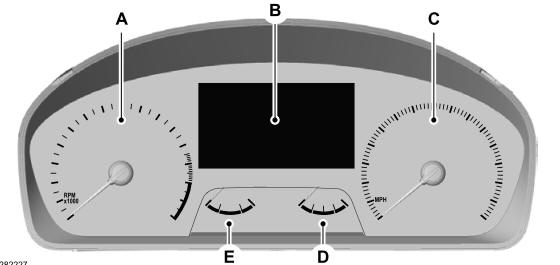
A - Tachometer.
B - Information display.
C - Speedometer.
D - Fuel gauge.
E - Engine coolant temperature gauge.
