Kia Picanto: Maintenance / Explanation of Scheduled Maintenance Items
Engine oil and filter
Change the engine oil and filter at the intervals listed in the Kia Picanto maintenance schedule. Vehicles regularly used under severe driving conditions need more frequent oil and filter changes.
Drive belts
Inspect all drive belts for cuts, cracks, excessive wear and oil contamination. Replace a belt if it is damaged or deteriorated. Check belt tension regularly and adjust it when necessary.
Caution
Before inspecting a belt, place the ignition switch in the LOCK/OFF or ACC position.
Fuel filter (petrol engines)
Petrol-powered Kia Picanto models use a fuel filter integrated with the fuel tank and designed to last for the vehicle’s service life. Routine replacement is generally unnecessary, although fuel quality can affect the filter. If you notice a safety-related problem or symptoms such as restricted fuel flow, surging, loss of power or difficulty starting, have the filter inspected and replace it if needed.
Fuel filter inspection and replacement should be carried out by a qualified workshop. Kia recommends contacting an authorised Kia dealer or service partner.
Fuel lines, fuel hoses and connections
Inspect the fuel lines, hoses and connections for leaks or damage. If any part needs replacement, have the work performed by a qualified workshop. Kia recommends using an authorised Kia dealer or service partner.
Vapour hose (petrol and FFV engines) and fuel filler cap
Inspect the vapour hose and fuel filler cap at the intervals specified in the maintenance schedule. When replacing either item, make sure the new part is fitted correctly.
Vacuum and crankcase ventilation hoses, if equipped
Check the hose surfaces for heat-related or mechanical damage. Rubber that has become hard or brittle, along with cracks, tears, cuts, abrasions or excessive swelling, indicates deterioration. Pay particular attention to hose sections close to high-temperature components such as the exhaust manifold.
Check that each hose is routed clear of heat sources, sharp edges and moving parts that could cause heat damage or wear. Inspect clamps, couplings and other connections to make sure they are secure and free of leaks. Replace any hose immediately if it shows signs of damage or deterioration.
Air cleaner filter
Have the air cleaner filter replaced by a qualified workshop. Kia recommends contacting an authorised Kia dealer or service partner.
Spark plugs (petrol and FFV engines)
Fit new spark plugs with the correct heat range for the engine.
During installation, use a soft cloth to clean the inside and outside of the bottom of the ignition-coil boot and the spark-plug insulator. This helps prevent contamination of the insulator.
Warning
Do not disconnect or inspect the spark plugs while the engine is hot. Hot components can cause burns.
Valve clearance (petrol 1.0 MPI and petrol 1.0 FFV engines)
Listen for excessive valve noise and check for unusual engine vibration. If adjustment is needed, have the system serviced by a qualified workshop. Kia recommends contacting an authorised Kia dealer or service partner.
Cooling system
Inspect the radiator, coolant reservoir, hoses and connections for leaks or damage. Replace any component that is damaged.
Coolant
Replace the coolant at the intervals specified in the maintenance schedule.
Manual transmission (MT) fluid, if equipped
Inspect the manual transmission fluid according to the maintenance schedule.
Automated manual transmission (AMT) fluid, if equipped
Inspect the AMT fluid at the intervals specified in the maintenance schedule.
Note
Using a fluid that is not specified for the transmission, even if it is labelled as compatible with the genuine fluid, may cause poorer shift quality and vibration and can eventually lead to transmission failure. Use only the specified AMT fluid. Refer to the section on recommended lubricants and capacities.
Automatic transmission (AT) fluid, if equipped
When the engine and transmission have reached normal operating temperature, the fluid level should be within the HOT range on the dipstick. Check the level with the engine running, the transmission in neutral and the parking brake firmly applied.
Note
Automatic transmission fluid is generally red when new and may become darker as the vehicle is driven. This colour change is normal; do not use fluid colour alone to decide whether replacement is needed.
Caution
Using fluid that is not specified for the transmission may cause a malfunction or transmission failure. Use only the specified AT fluid. Refer to the section on recommended lubricants and capacities.
Brake hoses and lines
Visually inspect the brake hoses and lines to confirm they are installed correctly and show no chafing, cracks, deterioration or leaks. Replace damaged or deteriorated parts immediately.
Brake and clutch fluid, if equipped
Check the fluid level in the brake or clutch reservoir. It must remain between the MIN and MAX marks on the side of the reservoir. Use only hydraulic brake or clutch fluid that meets the DOT 3 or DOT 4 specification.
Parking brake
Inspect the entire parking-brake system, including the lever or pedal and the cables.
Brake discs, pads and calipers
Check the brake pads for excessive wear, the discs for runout and wear, and the calipers for fluid leaks.
For additional details about checking brake-pad or lining wear limits, refer to the Kia website.
www.Kia-hotline.com
Suspension mounting bolts
Check suspension connections for looseness or damage. Retighten loose fasteners to the specified torque.
With the Kia Picanto stopped and the engine switched off, check the steering wheel for excessive free play.
Inspect the steering linkage for bends or damage. Check the dust boots and ball joints for deterioration, cracks or other damage, and replace any damaged parts.
Drive shafts and boots
Inspect the drive shafts, boots and clamps for cracks, deterioration or damage. Replace damaged parts and repack the grease if necessary.
Air-conditioning refrigerant, if equipped
Inspect the air-conditioning lines and connections for leaks or damage.
 Maintenance Schedule Under Severe Driving Conditions — Except Europe
When a Kia Picanto is regularly driven in any of the conditions listed below, follow the severe-service intervals in this schedule. Replace or inspect each item at the stated time or distance, as ..
 Engine Oil
Checking the Engine Oil Level
Engine oil lubricates moving parts, helps cool the engine and operates various hydraulic components. Some oil
consumption while driving is normal, so check the leve..
Other information:
Ford Explorer 2020-2026 Service Manual: Description and Operation - Electronic Engine Controls - Overview
Overview The EEC system provides optimum control of the engine through the enhanced capability of the powertrain control module (PCM). The EEC system also has an on board diagnostic (OBD) monitoring system with features and functions to meet federal regulations on exhaust emissions...
Ford Explorer 2020-2026 Service Manual: General Procedures - Locked Seatbelt Retractor Releasing
Repair NOTE: If the seatbelt webbing does not extract from the seatbelt retractor from the stowed position, this may be due to a normal condition which happens when the seatbelt retracts at a high rate of speed. Follow these steps to release the seatbelt...
Categories
- Manuals Home
- 6th Generation Explorer Owners Manual
- 6th Generation Explorer Service Manual
- Traction Control
- Automatic Transmission - 10-Speed Automatic Transmission – 10R60
- Body and Paint
- New on site
- Most important about car
Seatbelt Height Adjustment
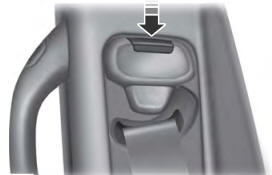
WARNING: Position the seatbelt height adjuster so that the seatbelt rests across the middle of your shoulder. Failure to adjust the seatbelt correctly could reduce its effectiveness and increase the risk of injury in a crash.