
Kia Picanto: Maintenance / Battery
For Best Battery Service
Figure 1. Petrol 1.0 MPI and 1.0 FFV
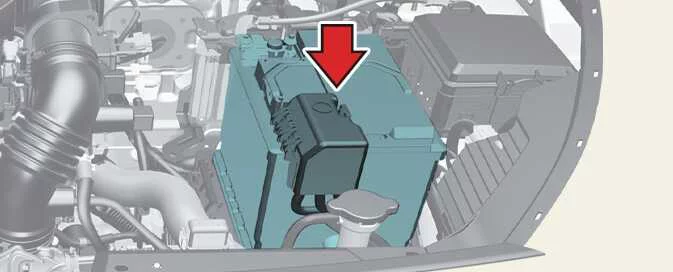
Figure 2. Petrol 1.2 MPI
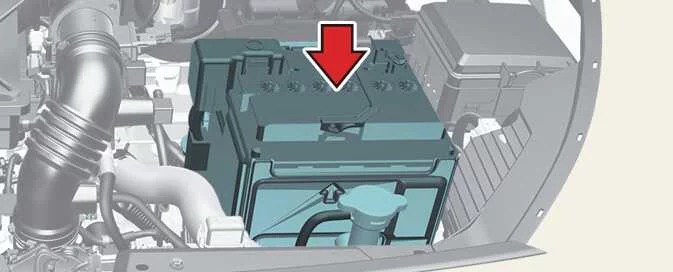
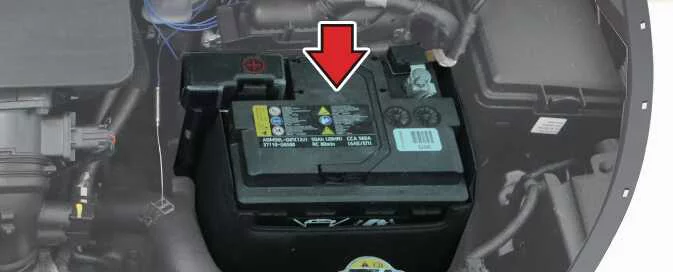
Figure 3. Smartstream G1.0 GDi
-
Make sure the battery is securely mounted.
-
Keep the top of the battery clean and dry.
-
Keep the terminals and connections clean and tight. Apply petroleum jelly or terminal grease to protect them.
-
If electrolyte spills, clean it up promptly with a solution of water and baking soda.
-
If the Kia Picanto will be out of use for an extended period, disconnect the battery cables.
Note
The standard battery is generally maintenance-free. If your vehicle has a battery marked LOWER and UPPER on the side, check that the electrolyte level is between these marks. If it is low, add distilled (demineralised) water only; never add sulphuric acid or other electrolyte. Avoid splashing the battery or nearby components, and do not overfill the cells, as this can cause corrosion on other parts. After topping up, make sure the cell caps are tight. Contact a qualified workshop for assistance. Kia recommends an authorised Kia dealer or service partner.
Warning
Battery hazards
 Read all battery-handling instructions
carefully before working with the battery.
 Keep lit cigarettes, flames and
sparks away from the battery.
 Battery cells constantly produce hydrogen, a
highly combustible gas that can explode if ignited.
 Keep batteries out of
children’s reach. Batteries contain highly corrosive sulphuric acid. Do not allow battery acid to contact your skin,
eyes, clothing or the vehicle’s paintwork.
 If electrolyte
gets into your eyes, flush them with clean water for at least 15 minutes and get immediate medical attention. If it
gets on your skin, wash the area thoroughly. If you feel pain or a burning sensation, seek medical attention
immediately.
 Wear eye protection when charging or
working near the battery. Always provide ventilation when working in an enclosed space.
 Improper
battery disposal can harm the environment and human health. Dispose of the battery in accordance with local laws and
regulations.
 The
battery contains lead. Do not discard it with ordinary waste after use. Contact a qualified workshop; Kia recommends
an authorised Kia dealer or service partner.
-
When lifting a battery with a plastic case, excessive pressure can cause acid to leak and lead to injury. Use a battery carrier or hold the battery at opposite corners.
-
Never try to recharge the battery while its cables are connected.
-
The electrical ignition system operates at high voltage. Never touch its components while the engine is running or the ignition is switched on.
Ignoring these warnings can result in serious injury or death.
Caution
-
If the Kia Picanto will not be used for an extended period in a cold area, disconnect the battery and store it indoors.
-
In cold conditions, keep the battery fully charged to help prevent damage to its case.
-
Unauthorised electrical devices connected to the battery may discharge it. Do not connect devices that are not approved for use with the vehicle.
Battery Capacity Label
Figure 1. Example
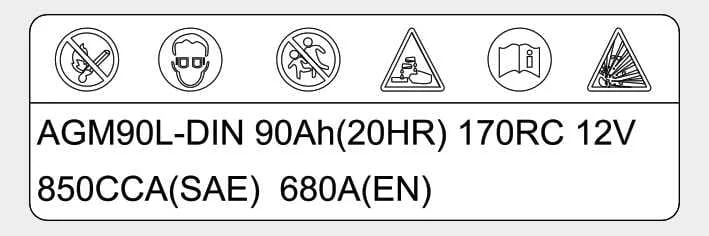
The battery label fitted to your vehicle may differ from the example shown.
-
AGM90L-DIN: Kia battery model designation.
-
90 Ah (20HR): Nominal capacity in ampere-hours.
-
170RC: Nominal reserve capacity in minutes.
-
12 V: Nominal voltage.
-
850 CCA (SAE): Cold-test current in amperes according to SAE.
-
680 A: Cold-test current in amperes according to EN.
Battery Recharging
The Kia Picanto is equipped with a maintenance-free, calcium-based battery.
-
If the battery becomes discharged quickly—for example, because the headlights or interior lights were left on while the vehicle was parked—recharge it slowly using a trickle charge for 10 hours.
-
If the battery gradually loses charge because of a high electrical load while the vehicle is in use, recharge it at 20–30 A for two hours.
Warning
Recharging the battery
Observe the following precautions whenever you recharge the battery:
-
Remove the battery from the vehicle and place it in a well-ventilated area.
-
Keep cigarettes, sparks and open flames away from the battery.
-
Monitor the battery while it is charging. Stop or reduce the charging rate if the cells begin to gas or boil vigorously, or if the electrolyte temperature in any cell rises above 49°C (120°F).
-
Wear eye protection when checking the battery during charging.
-
Disconnect the charger in this order:
-
Switch off the charger’s main power switch.
-
Remove the negative clamp from the battery’s negative terminal.
-
Remove the positive clamp from the battery’s positive terminal.
-
Warning
-
Before servicing or charging the battery, switch off all accessories and stop the engine.
-
When disconnecting the battery, remove the negative cable first. Reconnect it last.
-
Battery-related work should be carried out by a qualified workshop. Kia recommends contacting an authorised Kia dealer or service partner.
Caution
-
Keep the battery away from water and other liquids.
-
For safety, use specified replacement parts supplied through a qualified workshop. Kia recommends an authorised Kia dealer or service partner.
Items to Reset
After the battery has been discharged or disconnected, some Kia Picanto settings may need to be reset:
-
Automatic up-and-down window operation
-
Sunroof
-
Trip computer
-
Climate control system
-
Audio system
 Climate Control Air Filter. Filter Inspection. Wiper Blades
Climate Control Air Filter. Filter Inspection
Filter Inspection
Replace the climate-control air filter according to the maintenance schedule. If the vehicle is driven for long
periods in heavily..

Other information:
Kia Picanto 2024-2026 Owner's Manual: Suitability of each seating position for belted & ISOFIX Child Restraint Systems (CRS) according to UN regulations (For 4-seater, For Europe)
The following information is intended for vehicle users and Child Restraint System manufacturers. It describes seating-position suitability for the European four-seat Kia Picanto covered by this table. Yes: The seating position is suitable for fitting the specified category of Child Restraint System, subject to any accompanying footnote...
Ford Explorer 2020-2026 Service Manual: Removal and Installation - Rear Spoiler
Special Tool(s) / General Equipment Interior Trim Remover Removal NOTE: Removal steps in this procedure may contain installation details. Open the rear tail gate. Release the clips and remove the upper liftgate trim panel...
Categories
- Manuals Home
- 6th Generation Explorer Owners Manual
- 6th Generation Explorer Service Manual
- Description and Operation - Jacking and Lifting - Overview
- Removal and Installation - All-Wheel Drive (AWD) Module
- General Service Information
- New on site
- Most important about car
Child Safety Locks
When these locks are set, you cannot open the rear doors from the inside.
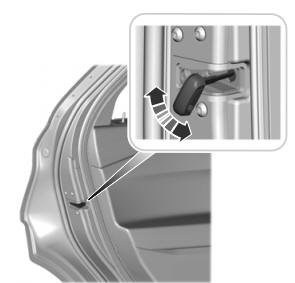
A child safety lock is on the rear edge of each rear door. You must set the child safety lock separately on each door.
Left-Hand Side
