
Kia Picanto: ISOFIX anchorage and top-tether anchorage (ISOFIX anchorage system) for children / Suitability of each seating position for belted & ISOFIX Child Restraint Systems (CRS) according to UN regulations (For 5-seater, For Europe)
The following information is provided for vehicle users and Child Restraint System manufacturers. It identifies the seating positions suitable for different categories of belted and ISOFIX restraints in the European five-seat Kia Picanto. Read each entry together with its installation conditions and footnotes before fitting a restraint.
-
Yes: The seating position is suitable for installing the specified category of Child Restraint System, subject to any conditions indicated by a footnote.
-
No: The seating position is not suitable for installing the specified category of Child Restraint System.
-
“-”: The entry is not applicable to the seating position shown.
-
The table is based on a left-hand-drive vehicle. With the exception of the front passenger seat, the same suitability information applies to a right-hand-drive vehicle.
For the front passenger seat in a right-hand-drive vehicle, identified as seating position 1, use the information listed for seating position 3. This accounts for the passenger seat being on the opposite side of the vehicle.
F: Forward-facing installation.
R: Rearward-facing installation.
| CRS categories | Seating positions | ||||||
|---|---|---|---|---|---|---|---|
| 1, 2 | 3 | 4 | 5 | 6 | |||
| Air bag ON | Air bag OFF | ||||||
| Universal belted CRS | All mass groups | - | No | Yes *1 F, R |
Yes F, R |
Yes F, R |
Yes F, R |
| i-Size CRS | ISOFIX CRF (F2, F2X, R1, R2) |
- | No | No | Yes | No | Yes |
| Carry-cot (ISOFIX lateral-facing CRS) |
ISOFIX CRF (L1, L2) |
- | No | No | No | No | No |
| ISOFIX infant* CRS (* Refers to an ISOFIX baby CRS.) |
ISOFIX CRF (R1) |
- | No | No | Yes R |
No | Yes R |
| ISOFIX toddler CRS — small | ISOFIX CRF (F2, F2X, R2, R2X) |
- | No | No | Yes *2 F, R |
No | Yes *2 F, R |
| ISOFIX toddler CRS — large* (* Does not include booster seats.) |
ISOFIX CRF (F3, R3) |
- | No | No | Yes *3 F |
No | Yes *3 F |
| Booster seat — reduced width | ISO CRF (B2) |
- | No | No | Yes | No | Yes |
| Booster seat — full width | ISO CRF (B3) |
- | No | No | Yes | No | Yes |
*1. To install a Universal Child Restraint System on the front passenger seat, adjust the passenger seatback to an upright position. This seatback setting is a condition of the suitability shown in the table.
*2. When installing an R2-size Child Restraint System, adjust the relevant front seat as follows to provide the required installation space:
-
Front driver’s seat: Set the seat height to its highest position.
If the driver’s seat has no height adjustment, move it to a position 10 mm forward of the midpoint of its fore-and-aft travel.
-
Front passenger seat: Move the seat fully forward to its foremost position.
*3. Seating positions 4 and 6 are not suitable for installing an R3-size Child Restraint System. The “Yes” entries for the large ISOFIX toddler category apply to the forward-facing installation indicated by F.
| Seat number | Position in the vehicle | Seating positions |
|---|---|---|
| 1 | Front left |
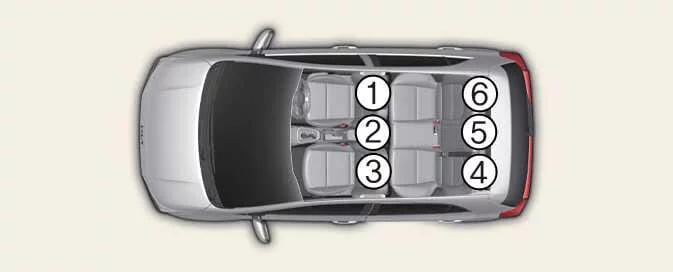
|
| 2 | Front centre | |
| 3 | Front right | |
| 4 | Second row, left | |
| 5 | Second row, centre | |
| 6 | Second row, right |
Never install a rearward-facing Child Restraint System on the front passenger seat unless the passenger air bag has been deactivated. Check the air bag status and the applicable suitability entry before fitting the restraint.
For semi-universal or vehicle-specific Child Restraint Systems, whether attached by ISOFIX or a vehicle seat belt, consult the vehicle compatibility list supplied in the restraint’s manual. Confirm that the restraint is suitable for your Kia Picanto and the seating position where you intend to use it.
If the vehicle headrest obstructs correct installation of the Child Restraint System, readjust the headrest at that seating position or remove it entirely as necessary. The headrest must not prevent the restraint from being positioned and secured correctly.
Recommended CRS for Vehicle according to UN regulations
This reference information is intended for vehicle users and Child Restraint System manufacturers. The table lists the recommended restraints by child height or mass group, together with their manufacturer, attachment method and ECE approval number. Match the restraint to your child’s size and check the seating-position requirements above before installation.
| Child height or mass group | Restraint name | Manufacturer | Attachment method | ECE approval number |
|---|---|---|---|---|
| 40–83 cm | BABY-SAFE 3 i-SIZE with FLEX BASE i-Sense |
Britax Römer | ISOFIX with support leg Rearward-facing installation |
E1*129R03/04*0060 |
| 76–105 cm | Trifix2 i-Size | Britax Römer | ISOFIX with top tether | 129R-010015 |
| 100–150 cm | Solution T i-Fix | Cybex | ISOFIX and vehicle seat belt | 129R-030036 |
| Group 3 | Booster Basic (Junior III) |
Graco | Vehicle seat belt | E11-0444165 |
CRS Manufacturer information
Britax Römer: www.britax-roemer.com
Cybex: https://cybex-online.com
Graco: https://www.gracobaby.com
 Suitability of each seating position for belted & ISOFIX Child Restraint Systems (CRS) according to UN
regulations (For 4-seater, For Europe)
The following information is intended for vehicle users and Child Restraint System manufacturers. It describes
seating-position suitability for the European four-seat Kia Picanto covered by this ..
 Suitability of each seating position for belted & ISOFIX Child Restraint Systems (CRS) according to UN
regulations (Except Europe)
This information is intended for vehicle users and Child Restraint System manufacturers. The table identifies
seating-position suitability for the categories of belted and ISOFIX restraints liste..
Other information:
Ford Explorer 2020-2026 Service Manual: Description and Operation - Message Center - System Operation and Component Description
System Operation System Diagram Item Description 1 RH steering wheel switch 2 PSCM 3 BCM 4 Door/liftgate ajar switches 5 GWM 6 SODR 7 Fuel pump and sender unit 8 IPC 9 APIM 10 Washer fluid level switch 11 Message center display 12 IPMA 13 Parking brake switch 14 ..
Ford Explorer 2020-2026 Service Manual: Description and Operation - Rear Suspension - Overview
Overview The rear suspension consists of the following components: Coil springs Lower arm and bushing assemblies Stabilizer bar and links Toe links Upper arms Lower arm vertical links Wheel bearing and wheel hub assemblies Wheel knuckles Wheel studs Suspension height sensor Dynamically controlled shock absorbers The rear suspension uses..
Categories
- Manuals Home
- 6th Generation Explorer Owners Manual
- 6th Generation Explorer Service Manual
- Engine
- Body and Paint
- Traction Control
- New on site
- Most important about car
Gauges
4 Inch Display
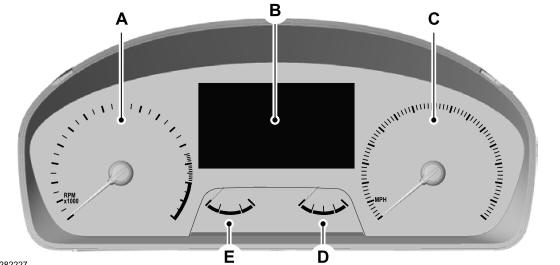
A - Tachometer.
B - Information display.
C - Speedometer.
D - Fuel gauge.
E - Engine coolant temperature gauge.
