
Kia Picanto: ISOFIX anchorage and top-tether anchorage (ISOFIX anchorage system) for children / Suitability of each seating position for belted & ISOFIX Child Restraint Systems (CRS) according to UN regulations (Except Europe)
This information is intended for vehicle users and Child Restraint System manufacturers. The table identifies seating-position suitability for the categories of belted and ISOFIX restraints listed for the Kia Picanto outside Europe. Read the relevant entry together with its footnotes, as some installations require specific seat adjustments or belt equipment.
-
Yes: The seating position is suitable for installing the designated category of Child Restraint System, provided all accompanying conditions are met.
-
No: The seating position is not suitable for installing the designated category of Child Restraint System.
-
“-”: The entry is not applicable to the seating position shown.
-
The table is based on a left-hand-drive vehicle. Except for the front passenger seat, the same information applies to a right-hand-drive vehicle.
For the front passenger seat in a right-hand-drive vehicle, identified as seating position 1, use the suitability information given for seating position 3.
F: Forward-facing installation.
R: Rearward-facing installation.
| CRS categories | Seating positions | ||||||
|---|---|---|---|---|---|---|---|
| 1, 2 | 3 | 4 | 5 | 6 | |||
| Air bag ON | Air bag OFF | ||||||
| Universal belted CRS | All mass groups | - | No | Yes *1 F, R |
Yes F, R |
Yes *2 F, R |
Yes F, R |
| i-Size CRS | ISOFIX CRF (F2, F2X, R1, R2) |
- | No | No | No | No | No |
| Carry-cot (ISOFIX lateral-facing CRS) |
ISOFIX CRF (L1, L2) |
- | No | No | No | No | No |
| ISOFIX infant* CRS (* Refers to an ISOFIX baby CRS.) |
ISOFIX CRF (R1) |
- | No | No | Yes R |
No | Yes R |
| ISOFIX toddler CRS — small | ISOFIX CRF (F2, F2X, R2, R2X) |
- | No | No | Yes *3 F, R |
No | Yes *3 F, R |
| ISOFIX toddler CRS — large* (* Does not include booster seats.) |
ISOFIX CRF (F3, R3) |
- | No | No | Yes *4 F |
No | Yes *4 F |
| Booster seat — reduced width | ISO CRF (B2) |
- | No | No | Yes | No | Yes |
| Booster seat — full width | ISO CRF (B3) |
- | No | No | Yes | No | Yes |
*1. When installing a Universal Child Restraint System on the front passenger seat, set the passenger seatback to an upright position. This adjustment is required for the installation indicated in the table.
*2. If the seating position does not have a shoulder belt, never install a rearward-facing Child Restraint System there. Check the belt equipment at the intended seating position before choosing an installation method.
If the seating position has no seat belt at all, do not install any Child Restraint System in that position.
*3. When installing an R2-size Child Restraint System, adjust the relevant front seat as follows:
-
Front driver’s seat: Raise the seat to its highest available position.
If the seat has no height adjustment, position it 10 mm forward of the midpoint of its fore-and-aft travel.
-
Front passenger seat: Move the seat fully forward to its foremost position.
*4. Seating positions 4 and 6 are not suitable for an R3-size Child Restraint System. The suitability shown for the large ISOFIX toddler category applies to the forward-facing installation identified by F.
| Seat number | Position in the vehicle | Seating positions |
|---|---|---|
| 1 | Front left |
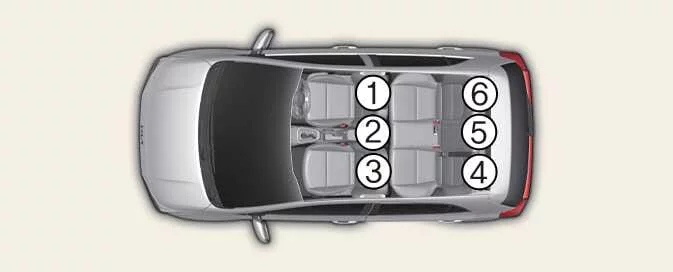
|
| 2 | Front centre | |
| 3 | Front right | |
| 4 | Second row, left | |
| 5 | Second row, centre | |
| 6 | Second row, right |
Never install a rearward-facing Child Restraint System on the front passenger seat unless the passenger air bag has been deactivated. Before installation, check both the air bag status and the suitability conditions for that seating position.
For semi-universal or vehicle-specific Child Restraint Systems, whether secured by ISOFIX or a seat belt, consult the vehicle compatibility list supplied in the restraint’s manual. Confirm that the listed application covers your Kia Picanto and the seating position you intend to use.
If the vehicle headrest prevents the Child Restraint System from being installed correctly, readjust the headrest at that seating position or remove it entirely as necessary. It must not interfere with the proper positioning and attachment of the restraint.
When installing a Child Restraint System on a second-row seat, move the seat to its mid-position. Also observe any specific seat-position requirements associated with the restraint category and the footnotes above.
Recommended CRS for Vehicle according to UN regulations (For LATIN Market)
The following information is provided for vehicle users and Child Restraint System manufacturers in the Latin market. It identifies the recommended restraint models, their mass groups, manufacturers and attachment methods. Check the applicable seating-position guidance and follow the instructions supplied with the selected restraint.
| Mass group | Restraint name | Manufacturer | Attachment method |
|---|---|---|---|
| Group 0+ | Citi SPS | Maxi-Cosi | Vehicle seat belt |
| Group I/II/III | Beline SP | Nania | Vehicle seat belt |
CRS Manufacturer information
Maxi-Cosi: www.maxi-cosi.com
Nania: www.groupeteamtex.com
 Suitability of each seating position for belted & ISOFIX Child Restraint Systems (CRS) according to UN
regulations (For 5-seater, For Europe)
The following information is provided for vehicle users and Child Restraint System manufacturers. It identifies the
seating positions suitable for different categories of belted and ISOFIX restra..

Other information:
Kia Picanto 2024-2026 Owner's Manual: Trip information (Trip computer) (For Type A cluster)
The trip computer is an electronically controlled driver information system that presents driving-related readings on the instrument cluster. In the Kia Picanto, it allows you to review journey information, monitor fuel economy and check the estimated distance available with the remaining fuel...
Ford Explorer 2020-2026 Service Manual: Description and Operation - Battery and Battery Charging Health and Safety Precautions
WARNING: Batteries contain sulfuric acid and produce explosive gases. Work in a well-ventilated area. Do not allow the battery to come in contact with flames, sparks or burning substances. Avoid contact with skin, eyes or clothing. Shield eyes when working near the battery to protect against possible splashing of acid solution...
Categories
- Manuals Home
- 6th Generation Explorer Owners Manual
- 6th Generation Explorer Service Manual
- Body and Paint
- Electric Parking Brake
- Engine - 2.3L EcoBoost (201kW/273PS)
- New on site
- Most important about car
Child Safety Locks
When these locks are set, you cannot open the rear doors from the inside.
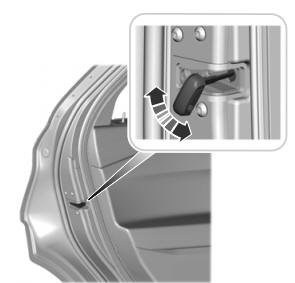
A child safety lock is on the rear edge of each rear door. You must set the child safety lock separately on each door.
Left-Hand Side
