Kia Picanto: Fuel filler door / Petrol reservoir in the engine room (Flex fuel vehicle, For Brazil and Paraguay)
If your Kia Picanto is a flex-fuel vehicle (FFV) supplied for Brazil or Paraguay, check the separate cold-start petrol reservoir when outside temperatures are low, particularly below 20°C. This reservoir must contain petrol for cold starting, so check its level and replenish it as necessary before operating the vehicle in these conditions.
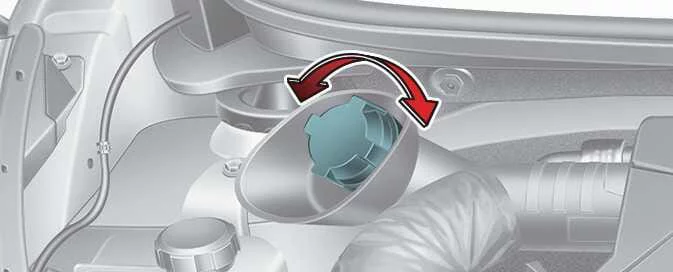
The cold-start petrol reservoir is located in the engine compartment and has a nominal capacity of 0.8 litres. Identify this reservoir using the illustration before filling it.
Add petrol for cold starting until the level reaches the MAX line. Do not fill beyond this mark. If petrol overflows, carefully wipe up the spilled fuel with a towel and remove the fuel-soaked towel from the engine compartment.
|
WARNING
Refuelling
-
Fuel released under pressure can spray onto your skin or clothing, creating a risk of fire and burns. Always loosen the fuel cap slowly and carefully. If fuel escapes or you hear a hissing sound, stop loosening the cap and wait until the release of pressure has ended before removing it completely.
-
When refuelling at a pump, stop when the nozzle shuts off automatically. Do not continue adding fuel or attempt to “top off” the tank after the automatic shut-off.
-
After refuelling, check that the fuel cap is securely installed. A correctly fitted cap helps prevent fuel from spilling in the event of an accident.
WARNING
Refuelling dangers
Automotive fuels are highly flammable and must be handled carefully. Follow the precautions below whenever you refuel your Kia Picanto or fill an approved portable container. Ignoring these instructions can lead to fire or explosion, causing severe injuries, serious burns or death.
-
Read and follow every warning displayed at the filling station. Observe the site’s safety instructions throughout the refuelling process.
-
Before beginning, locate the filling station’s emergency fuel shut-off control, if one is provided. Knowing its position allows you to identify it quickly if an emergency occurs.
-
Before handling the fuel nozzle, discharge any static electricity by touching a metal part of the vehicle well away from the filler neck, nozzle and other sources of fuel or vapour. Take this precaution before bringing your hand into the refuelling area.
-
Do not get back into the vehicle once refuelling has begun. Contact with seats, clothing and fabrics such as polyester, satin or nylon can generate static electricity through rubbing or sliding. A subsequent static discharge near the filler can ignite fuel vapour and cause a rapidly spreading fire.
-
When filling an approved portable fuel container, place it on the ground before dispensing fuel. Static discharge from the container can ignite fuel vapours and cause a fire.
Maintain the grounding contact established for refuelling until filling is complete, and avoid actions that could generate another static charge.
Use only approved portable plastic containers specifically designed for carrying and storing petrol. Do not substitute an ordinary household container.
-
Do not use a mobile phone while refuelling. Keep electronic devices away from the immediate filling area and follow the filling station’s restrictions on their use to avoid introducing a potential ignition source near fuel vapours.
-
Always switch off the engine before refuelling. Sparks from engine-related electrical components can ignite fuel vapours and start a fire. When filling is finished, confirm that the fuel cap and filler door are securely closed before restarting the engine.
-
Never use matches or a lighter, smoke, or leave a lit cigarette inside the vehicle while at a filling station, particularly during refuelling. Automotive fuel and its vapours can ignite readily when exposed to a flame or other ignition source.
-
If a fire starts during refuelling, move away from the vehicle and the immediate danger area. Alert the filling station manager immediately, then contact the local fire service. Follow the emergency instructions given by station personnel and emergency responders.
CAUTION
-
Use fuel that meets the specifications in the “Fuel requirements” section. Check the applicable requirements before filling either the main tank or the cold-start petrol reservoir.
-
If the fuel filler cap needs replacing, select a replacement specifically designed for your vehicle.
An unsuitable cap can cause a serious malfunction of the fuel system or emission control system. Kia recommends contacting an authorised Kia dealer or service partner for detailed replacement guidance.
-
Avoid spilling fuel onto the vehicle’s exterior. Any fuel that comes into contact with painted surfaces may damage the finish, so take care when filling and handling the cap or nozzle.
-
For fuel filler cap replacement, use Kia Genuine Parts or a part of an equivalent standard specified for your Kia Picanto. An incorrect cap can adversely affect the fuel system or emission control system and cause a serious malfunction.
-
Before leaving the refuelling area, check that the fuel cap has been securely refitted. This helps prevent fuel spillage if the vehicle is involved in an accident.
 Opening the fuel filler door. Closing the fuel filler door
Opening the fuel filler door
Open the Kia Picanto fuel filler door using the release lever inside the ..
 Sunroof : (if equipped)
If your Kia Picanto is equipped with a sunroof, use the switch on the overhead console to slide the gl..
Other information:
Ford Explorer 2020-2026 Service Manual: Removal and Installation - Evaporator
Removal NOTICE: Use extreme care when releasing the tabs on the climate control housing, or the tabs can be easily damaged. NOTE: Removal steps in this procedure may contain installation details. Remove the climate control housing. Refer to: Climate Control Housing (412-00 Climate Control System - General Information, Removal and Installation)...
Ford Explorer 2020-2026 Service Manual: Description and Operation - Module Controlled Functions - System Operation and Component Description
System Operation BCM The BCM controls various systems by monitoring inputs from switches, sensors and network messages from other modules and components on the HS-CAN1 and LIN. Based on these inputs, the BCM activates outputs. For example, the BCM monitors the HCM input...
Categories
- Manuals Home
- 6th Generation Explorer Owners Manual
- 6th Generation Explorer Service Manual
- Description and Operation - Identification Codes
- Engine - 2.3L EcoBoost (201kW/273PS)
- Removal and Installation - All-Wheel Drive (AWD) Module
- New on site
- Most important about car
Locking and Unlocking
You can use the power door lock control or the remote control to lock and unlock your vehicle.
Power Door Locks
The power door lock control is on the driver and front passenger door panels.